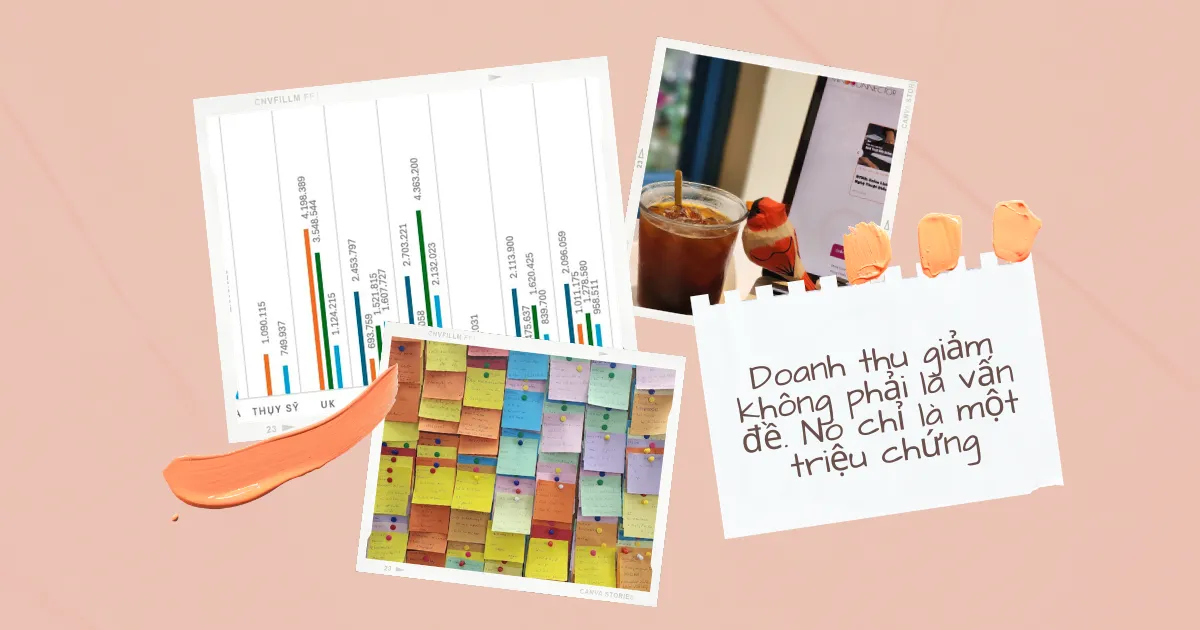
The founding generation (F1) spent decades building up their enterprises—establishing factories, developing products, and cultivating a reputation. This foundation enabled many Vietnamese manufacturing businesses to survive and grow over the course of 20 to 30 years. However, as these enterprises enter the phase of generational transition, the role of the second generation (F2) shifts. While the F1 generation succeeded by building production capabilities, the F2 generation faces a different challenge: how to develop the market for the next stage of growth.
Every generation of businesses faces its own unique set of challenges.
In our interactions with various family-owned enterprises, we have observed an interesting pattern.
When reflecting on their early days, founders often speak at length about the struggles of securing premises, purchasing machinery, recruiting workers, and scraping together the capital needed to keep production running.
That was a time when the primary objective was simply to create a product of sufficient quality.
If a business could offer a slightly better product than its competitors, deliver orders more reliably, and maintain greater trustworthiness, it had the opportunity to grow.
That was the landscape over two decades ago.
Today, however, many of these businesses already possess factories.
They have established teams.
They have defined processes.
They have a customer base.
The challenge facing the business is no longer a question of “whether it can be produced,” but rather how to sustain growth.

What the F1 generation leaves behind is not merely a factory.
When discussing generational succession, people often focus on assets.
Yet, the greatest legacy left by the F1 generation extends far beyond land, machinery, or production lines.
It encompasses reputation.
It includes long-standing client relationships.
It comprises a loyal workforce.
It represents experience accumulated through thousands of sound decisions—and the lessons learned from setbacks.
This constitutes a foundation that no newly established enterprise could build overnight.
Therefore, viewed objectively, the F2 generation begins from a far more advantageous position than the founders did.
Yet, precisely for this reason, they face a distinct set of pressures.

The market landscape for F2 differs significantly from that of F1.
While businesses once competed primarily based on production capacity, today that capability serves merely as an entry ticket to the game.
Customers have more choices.
There are more competitors.
Information is more transparent.
A business in Binh Duong can compete with one in Hanoi.
A Vietnamese enterprise may find itself competing against suppliers from China, Thailand, or Malaysia.
Geographical distance no longer offers the same advantage it once did.
This causes the market to evolve much more rapidly.
Consequently, the role of F2 can no longer be limited to simply running the factory more efficiently..

Building a market is not the same as doing marketing.
This is perhaps the most commonly misunderstood point.
When “building a market” is mentioned, many people immediately think of advertising, media, or social networks.
In reality, those are merely small components.
Building a market begins with understanding how customers are changing.
Who are the new customers?
How do they search for suppliers?
What do they care about when choosing a business?
Which markets still hold potential?
Which markets are becoming saturated?
The answers to these questions are not found inside the factory.
They lie out in the marketplace.
And that is where F2 needs to devote more time.

A business might invest in additional factory facilities, but the market does not expand on its own.
We once encountered a manufacturing company that invested in a new production line, anticipating a corresponding rise in revenue.
The factory operated more efficiently.
Capacity increased.
Production capabilities expanded.
Yet, after some time, revenue failed to meet expectations.
The reason did not lie in product quality.
Rather, it was because production capacity had outpaced market development capabilities.
This is a scenario frequently encountered among manufacturing enterprises.
Investments in factories are tangible—visible in the form of machinery, facilities, and capacity.
In contrast, investments in market development are often not immediately apparent.
However, in the long run, these two capabilities must develop in tandem.

The second generation (F2) does not simply need to do things differently from the first generation (F1); they need to do things that the first generation never had to do.
This is perhaps the most important perspective.
Many people assume there is an inherent difference in mindset between the first and second generations.
In reality, that is not entirely accurate.
Each generation is simply addressing the challenges of its own era.
If the first generation started out in an environment lacking capital, technology, and production capacity, then prioritizing the construction of factories was a logical choice.
If the second generation takes over in a landscape of fiercer competition, rapidly changing customer needs, and greater information transparency, then prioritizing market development is equally natural.
It is not a matter of who is more right.
It is simply that the challenges have changed.

Chuyển giao thế hệ không chỉ là bàn giao doanh nghiệp.
Một doanh nghiệp có thể chuyển giao quyền điều hành trong vài tháng.
Nhưng để chuyển giao được động lực tăng trưởng cho giai đoạn tiếp theo lại là một câu chuyện dài hơn.
Nhiều doanh nghiệp vẫn sở hữu nền tảng rất tốt.
Nhà máy vẫn hiện đại.
Sản phẩm vẫn cạnh tranh.
Đội ngũ vẫn giàu kinh nghiệm.
Điều còn thiếu đôi khi không phải là thêm một dây chuyền sản xuất, mà là một cách tiếp cận mới với thị trường.
Có lẽ, đó cũng là vai trò lớn nhất của thế hệ kế tiếp.
Không phải thay thế những gì F1 đã xây dựng.
Mà là tiếp tục mở rộng những giá trị ấy đến với nhiều khách hàng hơn, nhiều thị trường hơn và nhiều cơ hội tăng trưởng hơn.
Nhà máy là nền tảng để doanh nghiệp tồn tại.
Thị trường mới là nền tảng để doanh nghiệp tiếp tục phát triển.
Và đó có lẽ là hành trình mà rất nhiều doanh nghiệp gia đình tại Việt Nam đang bắt đầu bước vào.