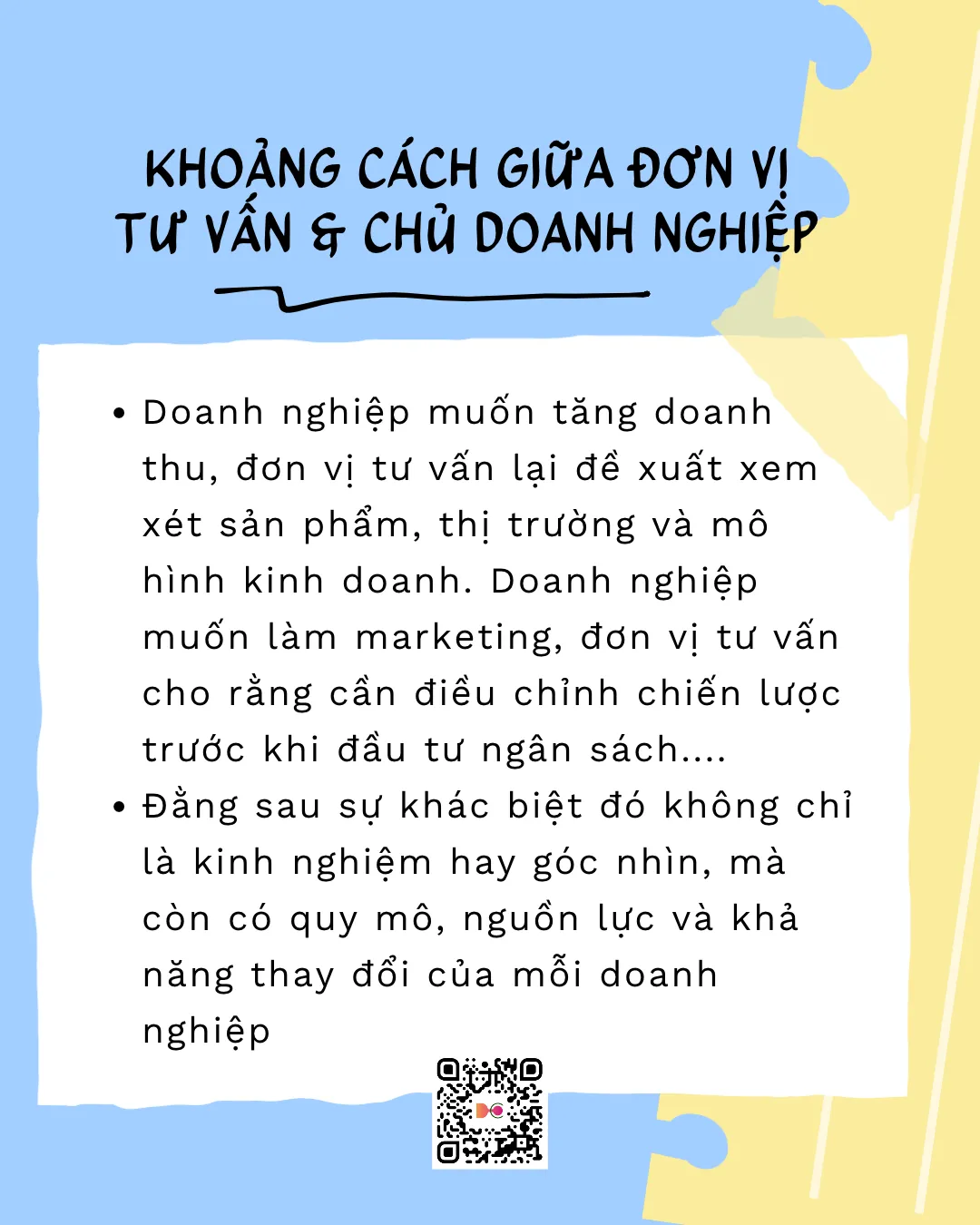
When a business seeks to increase revenue, its consultants might suggest re-examining its products, target markets, and business model. When a business wants to launch a marketing initiative, consultants might advise adjusting the overall strategy before committing any budget. Such discrepancies are not uncommon during a consulting engagement. Faced with the same issue, a business and its consultants may perceive different root causes and potential solutions. These differences stem not only from varying levels of experience or perspectives but also from the specific scale, available resources, and adaptability of the business itself.
When a business and its consultants perceive two different problems
When a business fails to meet its revenue targets, it often considers increasing advertising, expanding sales channels, or hiring more sales staff. These solutions are intuitive because they directly impact sales operations.
However, upon deeper analysis, consultants may discover that the root cause lies elsewhere: the product may not be well-suited to the target customer segment, the pricing strategy may lack competitiveness, the distribution channels may be inefficient, or the business may lack a sufficiently clear advantage to win over the market.
For instance, a manufacturing company might seek to boost sales by expanding its network of distributors. However, upon reviewing the business operations, the consulting firm discovers that the product lacks clear differentiation, the policies for distributors are not sufficiently attractive, and the supply capacity remains unstable.
If the company focuses solely on expanding its distributor network, it may increase the number of sales outlets, but this does not guarantee an improvement in revenue or profit.
In this scenario, both parties agree on the growth objective; however, they differ in how they define the necessary conditions to achieve that goal.
The company focuses on the immediate tasks at hand, while the consulting firm examines the underlying factors that may be hindering long-term results.
This is the first distinction that must be clarified: the problem the company intends to solve is not necessarily the root cause of its current difficulties.

The scale of a business can alter the feasibility of a consulting solution.
A solution that is suitable for a large enterprise may not necessarily be appropriate for a small business—a factor that is sometimes overlooked when developing a consulting roadmap.
Consider a common scenario: a business aims to build its brand and expand into the market.
For a large-scale enterprise, implementation might involve market research, customer segmentation, brand repositioning, product portfolio development, and the establishment of a distribution network.
However, for a small business—where the owner is directly responsible for operations, human resources, and financial management—a program of such scope can create immense pressure.
Such businesses often lack more than just a sufficient budget; they may also lack dedicated staff, market data, established operational processes, and the capacity to manage multiple simultaneous changes.
If a consulting firm proposes a roadmap that exceeds the business’s capacity to absorb change, the solution—no matter how sound it may be from a technical standpoint—will likely prove difficult to implement in practice.
Conversely, if a business clings to outdated practices simply because of its small scale, it risks stifling its own growth potential.
Therefore, a company’s size should not merely serve as a benchmark for determining the consulting budget. It should also inform decisions regarding priorities, the scope of change, and the pace of implementation.
An effective solution must not only address what a business should do, but also take into account what it is actually capable of doing at the present time.

The experience of a business and the approach of a consulting firm do not always align.
Business owners often possess practical experience accumulated over many years. They have a deep understanding of their customers, products, competitors, and operational challenges. Consequently, when a consulting firm offers an assessment that differs from their own experience, it is only natural for them to approach it with caution.
For instance, a business might believe its products have a solid market position because existing customers continue to make regular purchases. A consulting firm, however, might observe that the business is overly dependent on a specific, familiar group of customers and lacks the capacity to reach new market segments.
The two parties rely on different foundations for assessing the market.
The business bases its assessment on its existing operational results, while the consulting firm examines the potential to sustain and expand those results in the future.
However, the experience of a consulting firm has its limits; a model that proved successful for one company is not automatically suitable for another.
By relying solely on pre-existing methods and models, a consultant might overlook industry-specific nuances, customer behaviors, or internal constraints.
Therefore, the practical experience of the business and the analytical frameworks of the consulting firm should be considered in tandem, rather than using one to invalidate the other.

How can businesses and consulting firms find common ground?
Differences in perspective do not necessarily have to be resolved by one party persuading the other to adopt its point of view.
The first essential step is to clarify the basis for each perspective.
If a business believes that marketing efforts should be increased, it must examine sales data, the effectiveness of current channels, customer behavior, and conversion rates. Conversely, if a consulting firm suggests adjusting the product or the target market, that recommendation must also be supported by specific analytical evidence.
Next, the proposed solution must be evaluated within the context of the organization’s actual circumstances. A roadmap should not be developed based solely on the desired future state while disregarding existing resources.
Finally, both parties must agree on a set of priorities. Not every issue needs to be addressed simultaneously; some changes may require immediate action, others may need further preparation, and some initiatives should be rolled out in phases.
This approach prevents the organization from being overwhelmed by an overly ambitious transformation program from the outset, while simultaneously allowing the consulting team to verify the suitability of the solution at each stage of implementation.

Differences in perspective mark the starting point of the consulting process.
While businesses have a deep understanding of their own operations, they may lack the necessary detachment to gain a comprehensive view of existing issues. Conversely, consultants bring structured methodologies and an external perspective, yet they must also develop a sufficiently profound understanding of the context before proposing any changes.
Therefore, differences in viewpoints are not something to be avoided. What matters is that both parties are able to validate their assessments, recognize any inherent limitations, and reach a consensus on an appropriate course of action.
A solution is evaluated not only by its technical soundness but also by its feasibility for implementation within the specific, real-world context of a business.
This is because the goal of consulting is not to steer a company toward an idealized model on paper, but rather to identify a viable path that allows the business to reach a better state—leveraging its existing capabilities and resources.