Should business planning for the new year begin in October, or should it wait until the end of the year? When a business is focused on driving year-end sales and preparing for the Tet (Lunar New Year) shopping season, planning for the year ahead is often pushed aside. However, waiting until the peak season has passed may leave insufficient time to evaluate performance, define growth objectives, and secure necessary resources. Starting in October allows a business to be more proactive without neglecting its ongoing operations.
In October, should businesses focus on year-end (Tet) sales or on planning for the new year?
The answer is both—though not by splitting your time equally between the two.
Year-end sales are the immediate priority. Businesses must track orders, secure inventory, manage costs, and meet revenue targets. Neglecting these tasks to focus solely on planning will inevitably hurt current business performance.
Conversely, if you focus exclusively on sales through the Tet holiday, you will start your new-year preparations too late. Decisions regarding revenue targets, budgets, staffing, and market strategy require careful consideration; they cannot be handled effectively in just a few last-minute meetings at the end of the year.
Therefore, October is not the time to finalize your entire plan for the coming year. Instead, it is the moment to begin evaluating current performance, identifying issues that need to be addressed, and laying the groundwork for future decisions.

To set growth targets for the new year, businesses must first review this year’s results.
To determine how to achieve growth next year, a business must first understand the origins of this year’s performance.
For instance, suppose revenue has grown by 20%. While this may sound positive, if the bulk of that increase stems from a single large, one-off order, the business cannot assume that this revenue will recur next year.
Similarly, if sales growth was driven by deep discounting, it is essential to examine how much profit actually remains. If revenue increased due to the opening of new retail locations, but operating costs rose even faster, then this expansion may not have yielded better overall performance.
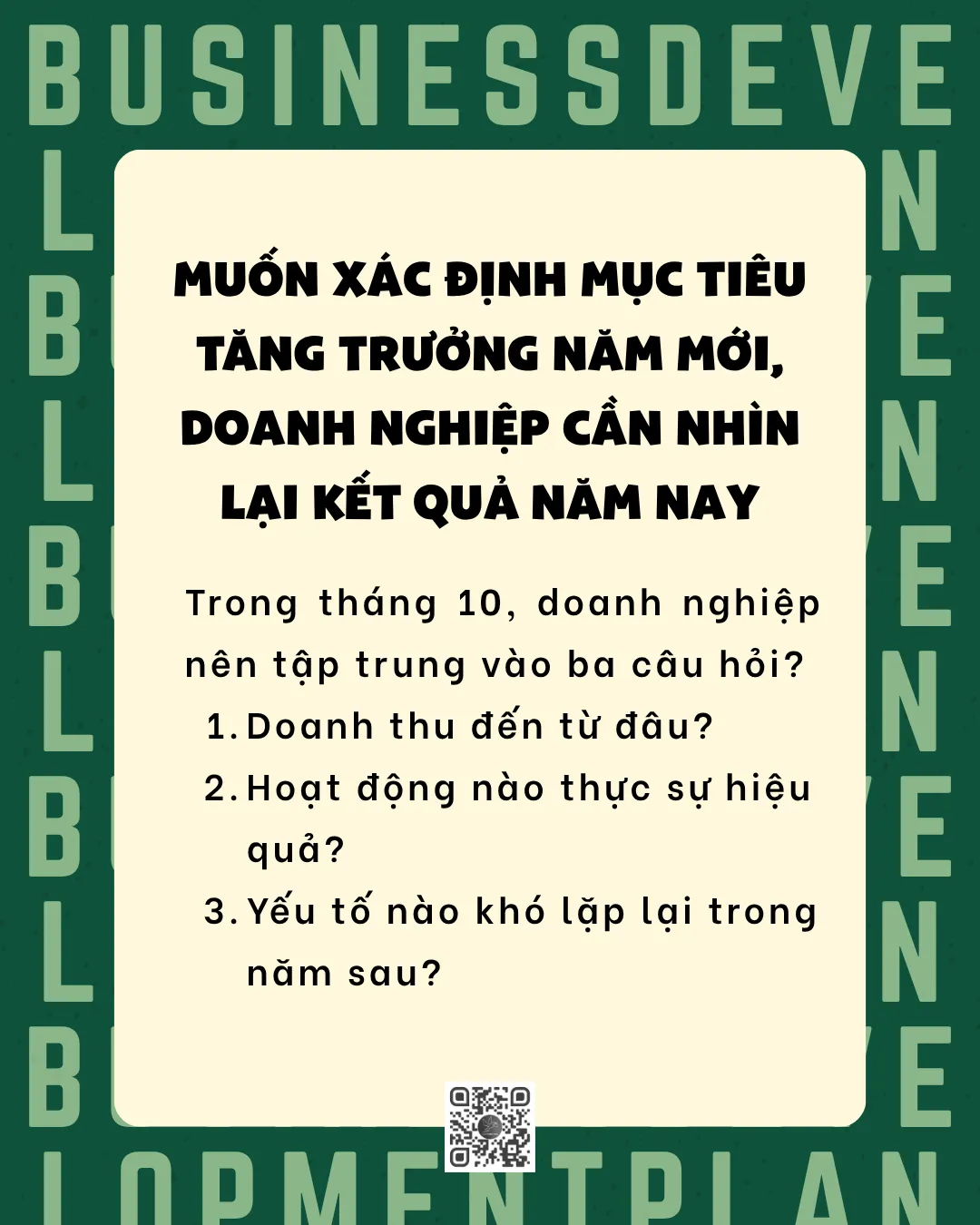
During the month of October, businesses should focus on three key questions:
- Where does the revenue come from? Is it from existing customers, new customers, core products, or perhaps a few one-off orders?
- Which activities are truly effective? Which products and sales channels generate profits that justify the costs incurred?
- What factors might be difficult to replicate next year—such as non-recurring contracts, special promotional campaigns, or particularly favorable market conditions?
There is no need to wait for the year-end summary report to get started. The data already available is sufficient to identify major trends and areas that warrant further investigation.
The purpose of this review is not to tally achievements, but rather to determine what continues to drive results—and what should not be taken as a default basis for growth in the coming year.
New Year Revenue Targets: Where Will the Growth Come From?
A target such as 20% growth may sound straightforward, but it does not specify what a business must actually do to achieve it.
If this year’s projected revenue is 50 billion VND and the target for next year is 60 billion VND, the question that must be asked is: where will the additional 10 billion VND come from?
Perhaps the business expects existing customers to purchase more, aims to acquire new customers, plans to expand distribution, or intends to launch new products. However, each of these options requires a solid rationale.
To increase revenue from existing customers, you must examine their likelihood of repeat purchases and their typical order value. To acquire new customers, you need to evaluate your target market, accessibility, and conversion rates. To expand sales channels, you must account for implementation costs, the time required to generate revenue, and operational capacity.
Therefore, before finalizing growth targets, a business must identify its projected revenue streams, the necessary resources, and the assumptions that require validation.
If you lack sufficient data, clearly outline what needs to be clarified during November and December. This approach is more practical than setting targets first and then scrambling to justify how they might be achieved.

Planning for the New Year: What Should You Tackle in October?
To ensure that the planning process doesn’t turn into an overly drawn-out project, businesses can get started by focusing on three specific tasks.
Task 1: Review business performance to date.
Consolidate data on revenue, profit, customers, products, and sales channels. Focus on the factors that drive the most significant impact; there is no need to analyze every single metric with the same level of detail.
Task 2: Determine key decisions for the coming year.
Should the business develop new products? Should it expand its distribution channels? Which customer segments should be prioritized? Which activities should be discontinued or receive less investment?
First, identify the decisions that will have a significant impact on revenue, profit, and resources, ensuring there is sufficient time to evaluate them.
Step 3: Compile a list of data points and assumptions that require clarification.
Expanding distribution channels requires data on consumption potential and costs. Developing a new customer base necessitates an assessment of market size and conversion rates. Increasing profitability calls for an analysis of product mix and cost structures.
By the end of October, the business should have a preliminary assessment, a list of options to consider, and a set of questions that need to be addressed. November and December should then be dedicated to validating findings, selecting the best course of action, and finalizing the plan—rather than starting from scratch.

Managing Year-End Sales and New Year Planning: How to Balance the Workload?
Planning ahead does not mean a business must divide its resources equally between these two tasks. The key is to structure the workflow so that urgent, immediate demands do not consume all the time needed for long-term strategic decision-making.
For year-end sales, it is essential to consistently monitor orders, revenue, inventory levels, delivery progress, and costs. Any issues that directly impact performance must be addressed immediately.
For New Year planning, schedule dedicated sessions focused on specific themes—such as evaluating customers and products, analyzing markets and distribution channels, or defining goals and budgets. Each session should be supported by pre-prepared data and result in clear, actionable conclusions.
The person in charge of sales does not need to handle the entire planning process alone. Other departments should provide relevant data and proposals, while leadership remains responsible for setting priorities and allocating resources.
This organizational approach allows a business to maintain momentum during the peak sales season while simultaneously preparing for the year ahead—ensuring that critical, long-term decisions are not repeatedly pushed aside.

Don’t wait until the end of the Tet season to start thinking about the new year.
In October, the priority remains hitting year-end sales targets. However, if a business focuses solely on immediate goals, preparations for the coming year will inevitably be pushed aside.
Starting in October does not mean you must finalize your entire plan immediately. Instead, it is the time to review business performance, identify viable sources of growth, and clarify the key decisions that need to be made before locking in targets, budgets, and resource allocations.
As the new year approaches, a business should already know where its growth will come from, where to invest, and what activities should be discontinued.
Do not let the pursuit of Tet sales leave your business entering the new year without a clear strategy for how it intends to grow.