When revenue falls short of expectations, marketing is often one of the first areas a business considers. Increasing advertising, refreshing the brand, expanding communication channels, or seeking a new marketing agency are common go-to solutions. However, not every business challenge can be resolved through marketing. In some cases, a company may attempt to boost customer reach while fundamental elements—such as the product, market segmentation, pricing, or the business model itself—are not yet truly well-aligned.

When marketing becomes the go-to solution for every revenue challenge
When a business experiences a decline in sales, it often raises questions such as: Why is brand awareness so low? Why are our advertisements ineffective? Should we increase our media budget? Or perhaps we need to switch to a different marketing agency?
These questions are not necessarily wrong. However, they often stem from a single underlying assumption: that the business is failing to generate sales simply because it hasn’t reached enough potential customers.
While that assumption might be valid, it may not accurately reflect the root cause of the problem.
Consider a fairly typical scenario: A company has a product that is—by its own internal assessment—a good one. It has invested in advertising and maintains a relatively steady stream of customer reach. Yet, the conversion rate remains low; customers may show interest and ask questions, but few actually make a purchase—or, if they do buy, they do so only once and never return.
A business might assume that its content lacks appeal, its advertising is not reaching the right audience, or its marketing team is underperforming.
However, a deeper look may reveal that the price point does not align with the value perceived by customers, the product fails to clearly address their needs, or the business is targeting the wrong customer segment.
Continuing to increase the advertising budget without addressing these underlying issues may result in more reach, but it will not necessarily generate meaningful, high-quality revenue.
While marketing can help a business better penetrate the market, it cannot serve as a substitute for a sound business strategy.

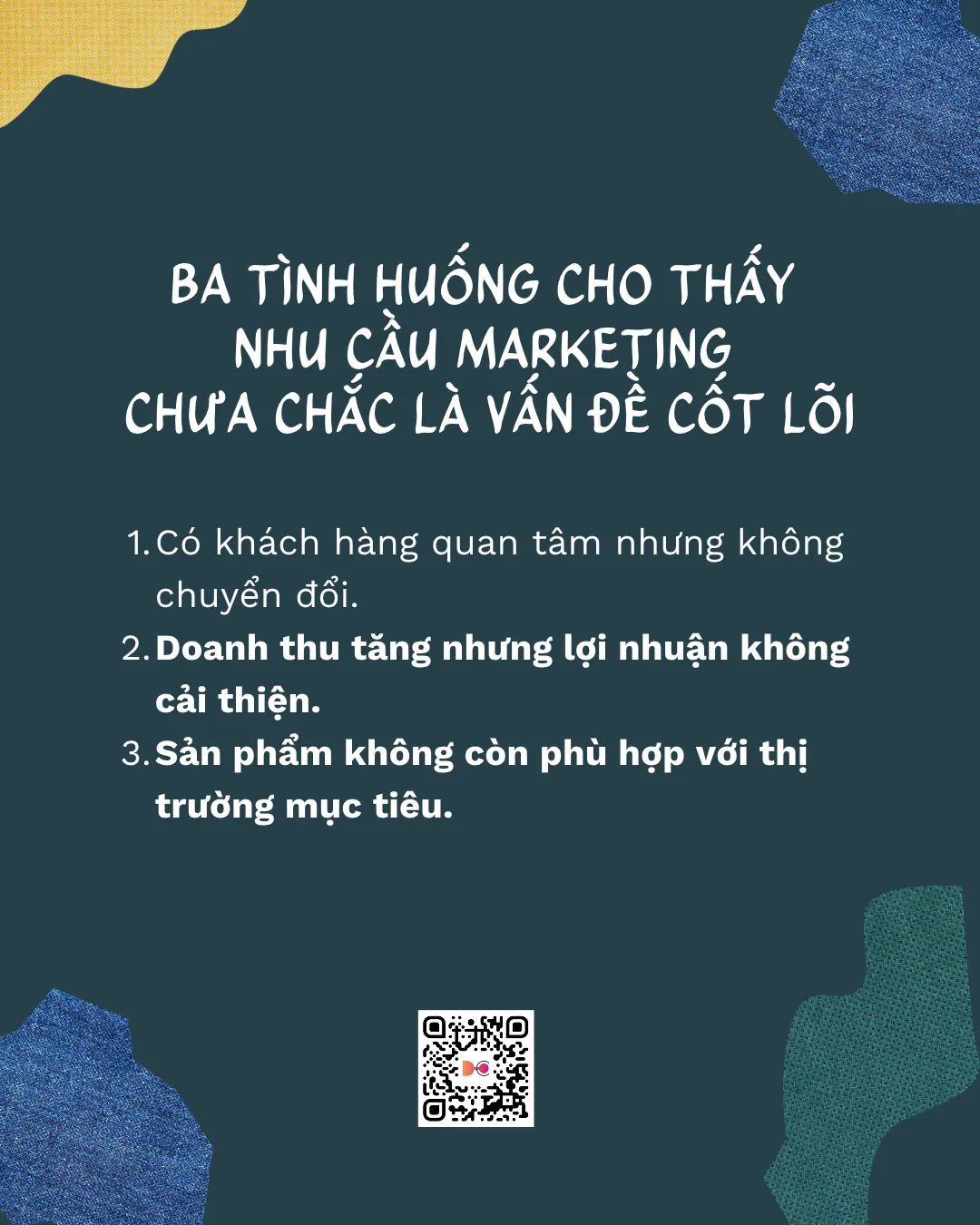
Three scenarios showing that a need for marketing is not necessarily the core issue
Scenario 1: Customers show interest but do not convert.
A business invests in marketing, attracting customers who reach out with inquiries—such as asking for prices—yet the actual number of orders remains low.
Looking solely at marketing efforts, one might be tempted to change the content, visuals, or advertising strategy.
However, it is necessary to investigate further: Is the product truly aligned with customer needs? Is the price point competitive? Are the sales policies persuasive enough? Could the consultation process itself be causing customers to lose interest?
In this case, increasing the number of customer touchpoints may not be the right priority. The first step should be to understand why those who have already shown interest are not completing a purchase.
Second scenario: Revenue increases, but profitability does not improve.
A business ramps up advertising, promotions, and the expansion of its sales channels. While sales volume grows, so do selling expenses, discounts, and operational costs.
If a company continues to prioritize revenue growth without evaluating the performance of individual products, channels, and customer segments, it may end up selling more while failing to achieve better overall business performance.
This is not merely a marketing issue; it concerns revenue structure, profit margins, and the strategic choices a business makes regarding its growth channels.
Third scenario: The product is no longer a fit for the target market.
A business may maintain the same product and approach to customers for years. When the market shifts—whether due to declining purchasing power or the emergence of competitors offering new alternatives—the business might conclude that it simply needs to refresh its image and ramp up its communications.
However, if customer needs have evolved, the root issue may actually lie with the product itself, its positioning, or the market segment the business is targeting.
While marketing can help communicate a product’s value, it cannot make an obsolete or irrelevant value proposition attractive simply by increasing the volume of communication..
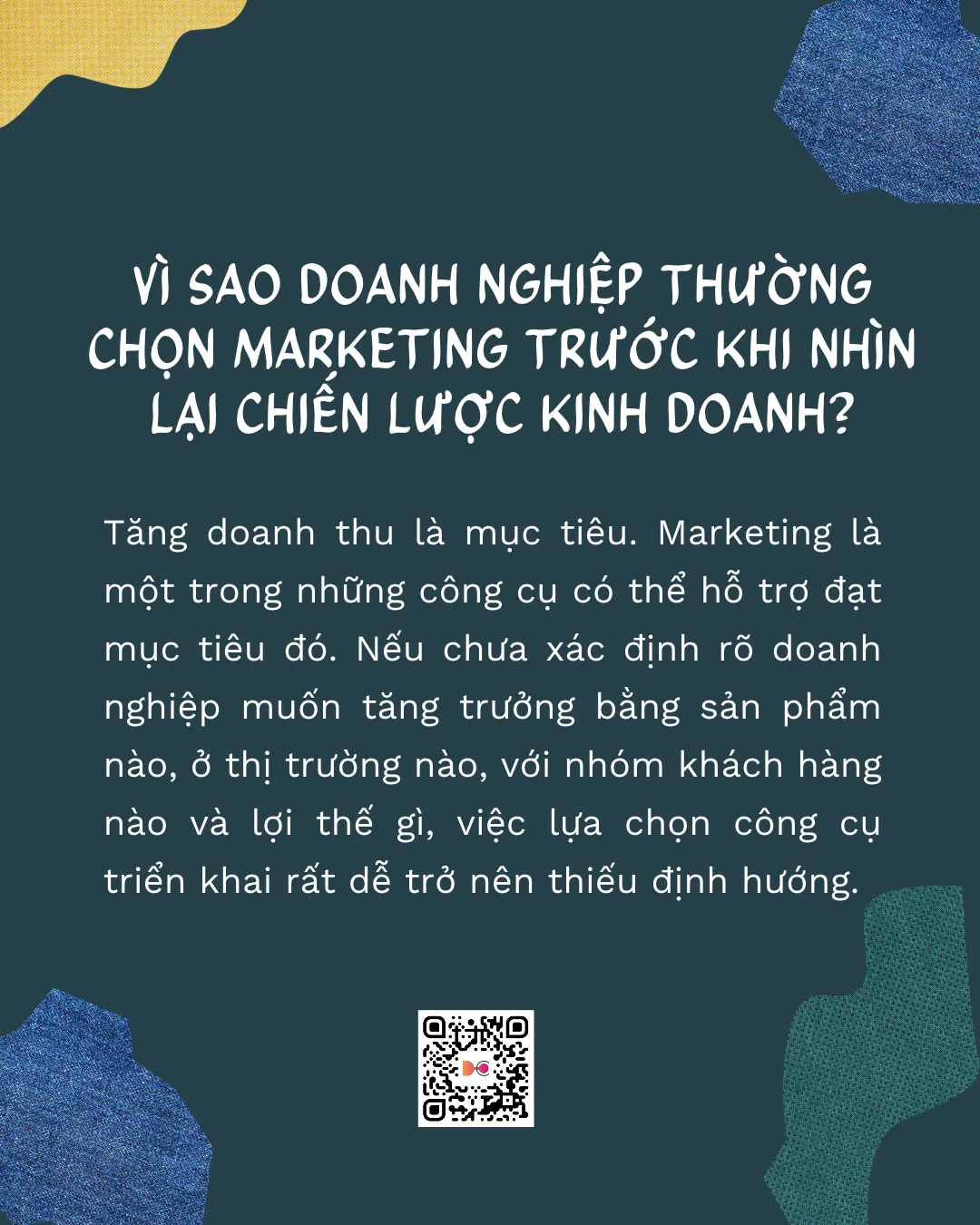
Why do businesses often focus on marketing before re-examining their overall business strategy?
There are three notable reasons.
First, marketing is highly visible. Businesses can easily observe advertisements, content, reach, the number of customer inquiries, and the costs involved in execution. When results fall short of expectations, it is natural to identify marketing as the area in need of adjustment.
In contrast, issues such as market segmentation, competitive advantage, product structure, or the underlying business model are often more difficult to discern and require a comprehensive assessment.
Second, marketing creates the impression that immediate action can be taken. A business might adjust its content, increase its budget, or hire additional staff. In contrast, re-evaluating a business strategy often entails more complex decisions—potentially even requiring changes to previous investments.
Third, a business may fail to clearly distinguish between its business objectives and the tools used to achieve them.
Increasing revenue is an objective, while marketing is one of the tools that can help reach that goal. If a business has not clearly defined how it intends to grow—specifying which products, markets, and customer segments it will target, and what its competitive advantages are—the selection of implementation tools can easily become aimless.
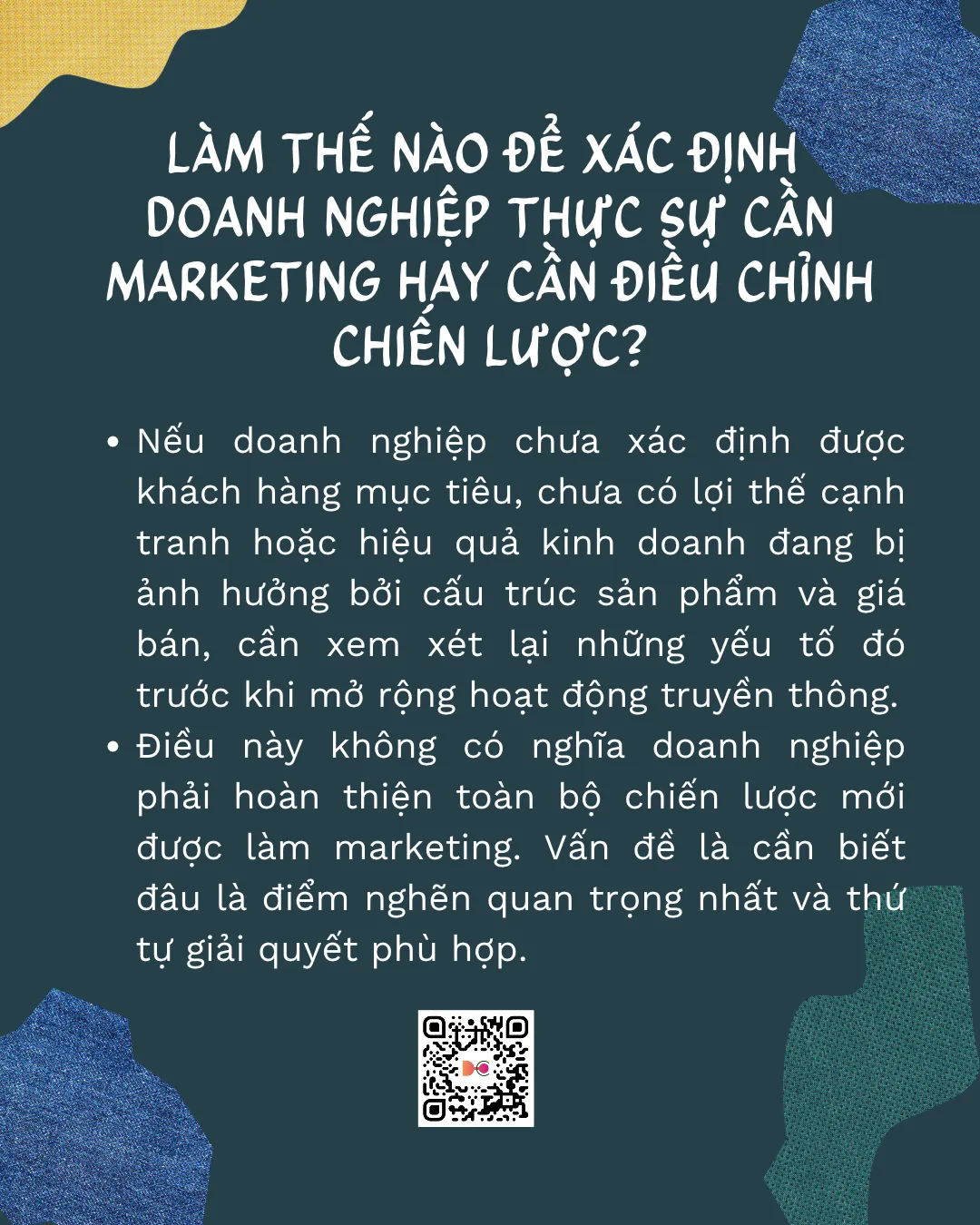
How can a business determine whether it truly needs marketing, or if it actually needs to adjust its strategy?
Before deciding to increase the budget or switch marketing providers, a business should revisit a few fundamental questions.
- Regarding the market: Is the business serving the right customer segment—those who have both the need and the ability to pay?
- Regarding the product: Does the product address a clear, well-defined need, and does it provide a compelling reason for customers to choose it?
- Regarding competition: What distinct advantages does the business hold compared to other options currently available in the market?
- Regarding business performance: How are revenue, sales costs, and profit trending?
- Regarding marketing: Where exactly does the bottleneck lie—in reaching, attracting, converting, or retaining customers?
These questions help a business determine whether an issue stems from its marketing execution or from the underlying business decisions.
If a product is a good fit, the target market is clearly defined, and the business model is sound—but the company struggles to reach customers—then marketing may be the area that requires investment.
Conversely, if a business has yet to identify its target audience, lacks a competitive advantage, or is seeing its performance hindered by its product structure or pricing, these factors must be addressed before scaling up marketing and communication efforts.
This does not mean a business must perfect its entire strategy before engaging in marketing. The key is to identify the most critical bottleneck and determine the appropriate sequence for addressing it.
Marketing cannot replace business decisions.
A business may invest heavily in marketing yet still fail to achieve the desired results if its foundational decisions are not well-aligned.
Conversely, a sound business strategy requires marketing to deliver products and value to the right market.
While these two functions are closely interconnected, neither can substitute for the role of the other.
Before seeking to improve their marketing, businesses must ensure they are addressing the right problem. If the root cause lies within the product, the market, or the business model, then enhancing promotional efforts will only treat the symptoms rather than the underlying issue.
Sometimes, what a business needs is not more marketing, but a clearer understanding of what it is actually selling, whom it serves, and why customers should choose it.