In the course of advising businesses, I often encounter a rather interesting scenario: a potential partner proactively reaches out with a desire to collaborate. This could be a distributor looking to expand into new markets, a company with a complementary customer base, an investment fund, a technology firm, or simply a business seeking a partner for mutual growth.

At the time, both sides saw the potential.
But then, things gradually went quiet.
There was no outright rejection, nor were there any major conflicts or disagreements. It was simply that, after the initial meeting, the business returned to its day-to-day operations. Email responses slowed down, scheduled meetings were repeatedly postponed, and discussions dragged on due to a “need for more time to evaluate.” Six months later, when the business sought to reconnect, the partner had already launched a similar project with another provider.
Many businesses feel they have “lost” a partner in such situations.
In reality, they missed a window of opportunity.
In business, partnership opportunities are much like investment opportunities: they do not last forever. There is an optimal moment for both parties to align their vision. Once that moment passes, it is not just the partners who change, but also the market landscape, strategic priorities, and the expectations of each side.
That is why many deals fail—not because the parties are incompatible, but because they simply failed to connect at the right time.
Don’t Confuse “Partnership” with “Transaction”
One reason businesses miss out on many partnership opportunities is that they approach every collaboration proposal from a transactional perspective.
The first questions asked are often:
“How much revenue will this generate?”
“Will it yield immediate profit?”
“If it doesn’t result in an order, what is the point of the partnership?”
Those questions are perfectly valid if a business is purchasing a product or hiring a service. However, partnerships do not operate according to the logic of a short-term transaction.

A strategic partnership often generates value over time. Some partners may not yield immediate revenue in the first year but can help a business shave three years off the time required to build a market presence. Others may not generate direct profits but open doors to customers that the business could otherwise hardly reach on its own.
If partnerships are measured solely by immediate revenue, businesses risk overlooking long-term value that does not appear on the balance sheet.
Partners seek more than just a product
Many businesses believe that partners seek them out because of their quality products or competitive pricing.
In reality, that is only a small part of the picture.
In partnerships, what matters to the other party is not merely current capability, but also the potential for a long-term journey together. They observe how a business responds to information, the speed of its decision-making, its willingness to share resources, its level of transparency, and the consistency between its words and actions.
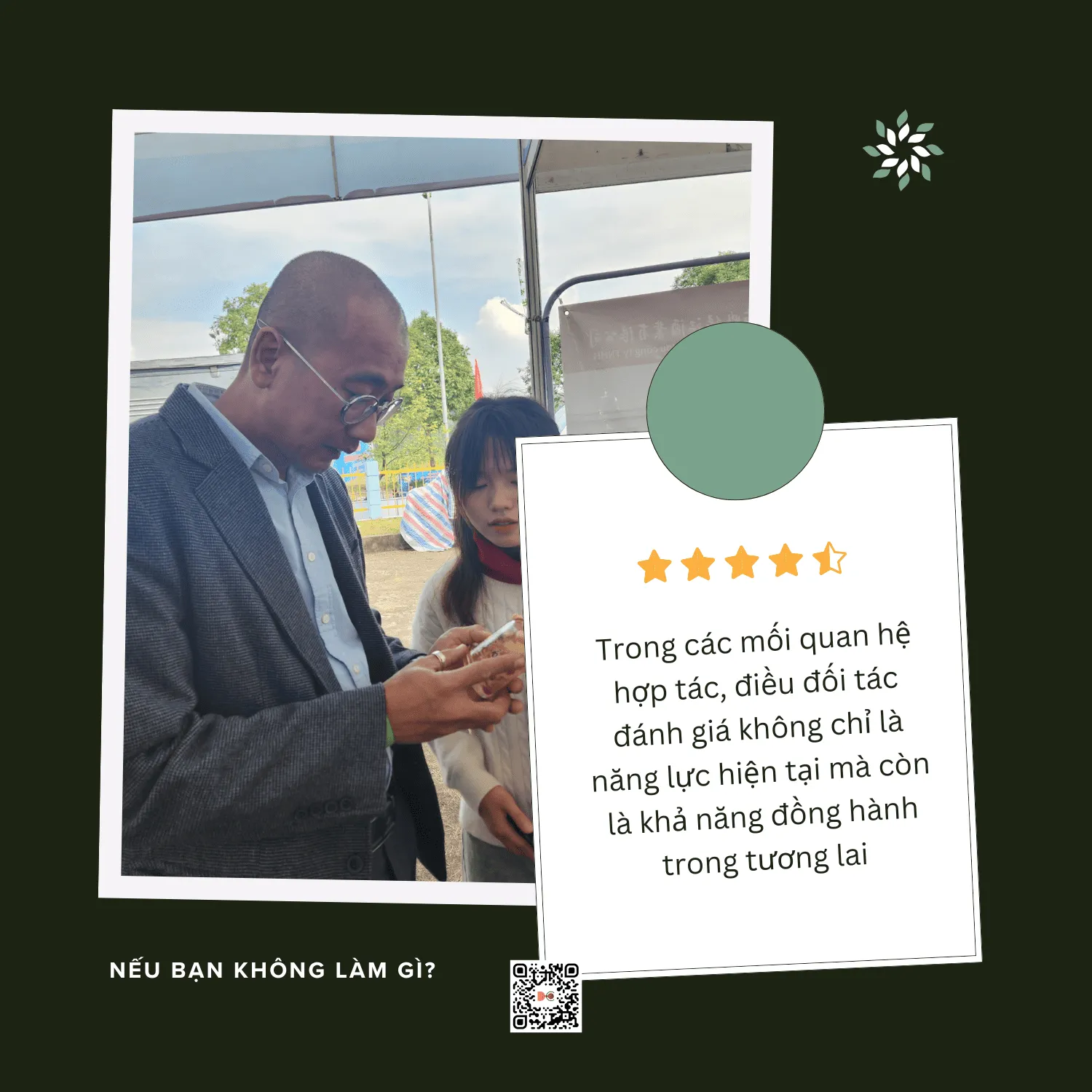
A business offering an excellent product can still be ruled out of negotiations if it is slow to respond, lacks commitment, or communicates unclearly.
The reason is simple: a partnership entails a high degree of mutual interdependence. A partner is not merely selecting a product; they are choosing an organization with which they will work closely for years to come.
Consequently, the evaluation process begins at the very first meeting, rather than waiting until the contract is signed.
Every cooperation opportunity has a “shelf life.”
A common mistake businesses make is assuming that if a partner is truly interested, they will simply wait.
This rarely happens.
During that same period, the partner is likely meeting with other businesses, evaluating other options, and facing pressure to meet their own business objectives.

If a business takes three months to make a decision while a partner has only one month to execute a plan, the opportunity will likely vanish before the business can even provide an answer.
This is not a matter of right or wrong; it is a matter of speed.
In strategy, speed determines not only the ability to execute but also the ability to seize opportunities.
Many businesses do not fail because they lack capability; they fail because their decision-making cycle outlasts the lifespan of the opportunity itself.
Partnerships do not always begin with a major contract.
There is a common misconception that a partnership is only meaningful when both parties sign a comprehensive agreement.
This leads many businesses to either commit to a massive partnership or do nothing at all.
This is a rather extreme approach.

In reality, many strategic partnerships begin with very small-scale projects.
A co-hosted program.
A pilot product.
A specific market segment.
A particular customer group.
A joint marketing campaign.
Small-scale projects allow both parties to understand each other’s working styles and assess compatibility before committing to larger investments.
This approach also significantly reduces risk for the business. Instead of spending months analyzing whether to partner, the company can spend that time collaborating on an actual project. The project’s outcome invariably provides a more convincing answer than any presentation.
What businesses often underestimate is “opportunity cost.”
When rejecting or delaying a partnership opportunity, companies typically focus only on the required investment.
This might involve resources, time, budget, or personnel.
Yet, very few businesses ask themselves:
“If the partnership succeeds, how much time could we save?”
“If this partner chooses another company, how will our competitive position change?”
“If we did it ourselves, how long would it take to build what the partner already has in place?”
This is the concept of opportunity cost—a type of cost that is rarely measured yet has the most significant impact on growth.
Some businesses spend three years building a distribution system that could have been established in just six months had they chosen the right partner. Some brands invest tens of billions of dong to reach new customers, whereas a suitable partnership could have significantly shortened that journey.
Not every partnership creates value. However, a business will never know unless it takes the time to seriously evaluate the possibilities.
Partnerships are a test of leadership mindset.
Through years of consulting, I have observed that businesses capable of building strong ecosystems share a common trait. They do not view partners merely as a means to boost sales; instead, they regard them as an integral part of their long-term growth strategy.
This fundamentally shapes their decision-making process.
They do not simply ask, “What does this partner bring to the table?”
They also ask, “What value can my business create for the partner?”

This seemingly minor distinction determines the quality of the entire relationship.
A sustainable partnership is not built on one party extracting value from the other; rather, it is built on both parties creating mutual value.
That is precisely why businesses that approach partnerships with a mere “buy-and-sell” mindset often struggle to establish long-term strategic alliances.
Mind Connector’s Perspective
At Mind Connector, we do not view partnerships merely as a business development activity. We regard them as strategic decisions capable of transforming a business’s growth trajectory.
The right partner does more than just help a business sell more products; they can accelerate time-to-market, lower the costs of testing new models, scale operational capacity, or fill critical capability gaps.

Conversely, missing out on a strategic partner means more than just losing a collaboration opportunity; in many cases, it effectively enables that partner to become a source of competitive advantage for a rival firm.
Therefore, the question leadership should ask is not “Should we partner with this entity?” but rather, “What stands to be lost over the next three to five years if we do not partner with them?”
Viewed from this perspective, the decision shifts from a matter of a single contract to one of future competitive positioning.

What if you do nothing?
Not every partnership proposal is worth pursuing, but every partnership opportunity deserves serious consideration.
In a market where the pace of change is accelerating, few businesses can independently possess all the resources needed for growth. Competitiveness is no longer defined solely by what a business owns, but also by the partners it chooses to join forces with.
Sometimes, the gap between a rapidly growing business and a slow-growing one does not lie in products or capital investment. It stems from a seemingly small decision: one side proactively opens the door to collaboration when an opportunity arises, while the other assumes that the opportunity will simply wait for them.