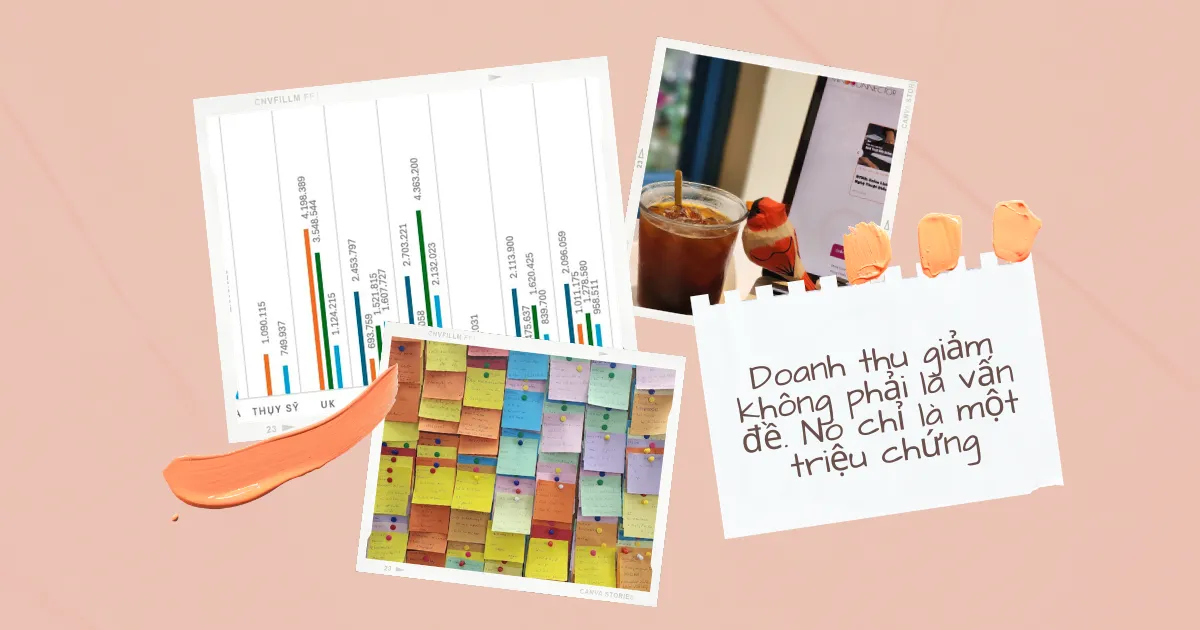
For years, investing in manufacturing facilities, enhancing product quality, and optimizing production capacity have been top priorities for businesses. This is entirely valid, as production forms the foundation for a company’s survival and growth. However, as markets become increasingly competitive and customers gain more choices, production capacity is gradually shifting from a competitive advantage to a mere prerequisite. So, what will set a business apart in the next phase?

A fairly common mindset among many manufacturing businesses.
When sales fall short of expectations, the conversation often centers on the factory.
- Should we invest in additional production lines?
- Should we replace the machinery?
- Should we expand capacity?
- Should we improve processes to reduce costs?
These are all crucial decisions—areas where many businesses have excelled over the years.
Many companies have built a competitive edge through stable production, consistent quality, and competitive pricing. It is precisely these factors that have enabled them to gradually expand their markets and scale up operations.
However, looking at the current landscape, a common trend is emerging across many industries.
A company invests in a new factory.
Its competitor does the same.
A company upgrades its machinery.
Its competitor follows suit.
As production technology becomes increasingly accessible, the gap in production capabilities between companies is narrowing.
When this happens, the nature of competitive advantage begins to shift.

What once set a business apart has now become the standard.
Ten or fifteen years ago, a company with a modern production line often enjoyed a distinct advantage.
Customers placed greater trust in them.
Productivity was higher.
Quality was more consistent.
Today, however, many businesses within the same industry can invest in similar technologies.
A paintbrush manufacturer can source machinery from the same supplier.
A packaging company can utilize production lines comparable to those of its competitors.
A mechanical engineering firm can invest in modern machining centers that differ little from the rest of the market.
This does not mean that investment in production is no longer important.
On the contrary, it remains a prerequisite.
But if everyone meets the same standard, customers will have to look for other reasons to make their decisions.

Customers rarely see what a business is most proud of.
This is a rather interesting paradox.
Many businesses spend years perfecting their production processes.
Investing in machinery.
Training their teams.
Enhancing quality.
Yet, customers often have few opportunities to witness these efforts.
What they see first is usually how the business presents itself to the market.
Is the website professional?
Is the information clear?
Does the consulting team understand customer needs?
Are response times fast?
Has the business executed similar projects before?
These are the initial touchpoints before customers even have the chance to evaluate product quality.
If a business excels internally but the market fails to perceive it, that production advantage will be difficult to translate into a business advantage.

Many businesses are competing in areas that no longer matter much to customers.
Consider a business capable of producing 100,000 units per month.
Yet, actual customer demand stands at only 40,000 or 50,000 units. In this scenario, a capacity advantage no longer generates as much value as it once did.
What customers care about is:
Delivery times.
Product customization capabilities.
After-sales service.
The level of partnership and support provided by the supplier.
Or simply, the reliability of a long-term relationship.
In other words, customers are not just buying a product.
They are choosing a partner.
That is why many smaller-scale businesses continue to thrive in market segments where they truly understand their customers.

When quality is no longer a differentiator.
This is perhaps the issue that troubles business owners the most. “We always put quality first”—this is a sentiment shared by many businesses.
While quality is undoubtedly a crucial factor, try putting yourself in the customer’s shoes: if five different businesses all claim their products are of high quality, what criteria will the customer use to make a choice?
They will start looking at other factors.
Which business understands their industry better?
Which business responds faster?
Which business projects a more professional image?
Which business gives them the confidence to enter into a long-term partnership?
At this point, the differentiator is no longer solely the product.
It lies in the experience the business delivers to the customer.

It is not just factories that are worth investing in.
Many businesses have dedicated the bulk of their resources to expanding production.
That was a sound decision when the market was continuing to grow as it had before.
But as market growth slows, the question is no longer “how much can we produce?”
The question shifts to “to whom do we sell?”
How can customers become aware of the business?
How can the business reach new markets?
How can the business retain existing customers while expanding into other customer segments?
These are investments that are not immediately visible in the form of machinery or factory facilities.
Yet, they determine long-term growth potential.

It is time to view manufacturing through a different lens.
Manufacturing remains the foundation.
Without quality products, a business can hardly achieve sustainable growth.
However, in the current landscape, manufacturing should be viewed as a core capability for delivering on promises to customers, rather than as the sole competitive advantage.
A business’s competitive advantage is increasingly shaped by a combination of factors.
These include a deep understanding of the customer.
The ability to build trust.
The speed of market adaptation.
And the way the business creates experiences throughout the course of the partnership.
And, of course, all of this must still be underpinned by robust manufacturing capabilities.
Looking back at the growth journeys of many successful enterprises, a thought-provoking commonality emerges.
In the initial stages, they succeeded by producing superior products.
However, as they moved into the next phase of growth, few continued to expand solely by investing in more factories. Instead, they began investing more heavily in understanding the market, building their brand, developing sales systems, expanding distribution channels, and creating value that competitors found difficult to replicate. Ultimately, this is not a story of replacing manufacturing with marketing or branding; it is a story of balance.
Once production capacity is established as a foundation, a business requires new capabilities to sustain growth. Perhaps the question many enterprises should be asking themselves is no longer: “How can we produce more?”
But rather: “What will make customers continue to choose us when other businesses can manufacture just as well as we do?”
That may well be the more critical question for the next stage of the business’s development.