One change that many investors have noticed very clearly in recent years is that businesses are becoming more and more prepared. Reports are thicker. Analyses are more thorough. When asked, the answers are usually smooth, supported by evidence, data, and even scenarios A, B, and C. The “lack of information” of the past is no longer present.

But the paradox lies elsewhere.
The more information businesses have, the more hesitant they become.
Decisions are no longer as decisive as before, and some businesses even delay things for a long time, even when opportunities don’t wait.
From an investor’s perspective, this is a sign worth considering.
In the past, businesses made mistakes due to a lack of information.
If we go back ten or fifteen years, when talking about wrong decisions, people often attributed it to a very familiar reason: a lack of information. No market data. A lack of understanding of customer behavior. A lack of knowledge of industry cycles. Decisions were made based heavily on intuition, personal experience, or subjective beliefs.
At that time, mistakes were understandable. And when mistakes were made, businesses could even say: “We didn’t know then.”

Investors, when looking at the situation, also have a certain degree of sympathy. The market environment lacks transparency. Analytical tools are limited. Decision-making is like walking in a fog.
Now the fog has cleared, but the fear is greater.
Today, the fog is almost gone. Information is everywhere. With just a few clicks, businesses can access industry reports, trend analysis, user data, and even AI-based future forecasts.
But at this very moment, investors are seeing another phenomenon: businesses are afraid to make mistakes.
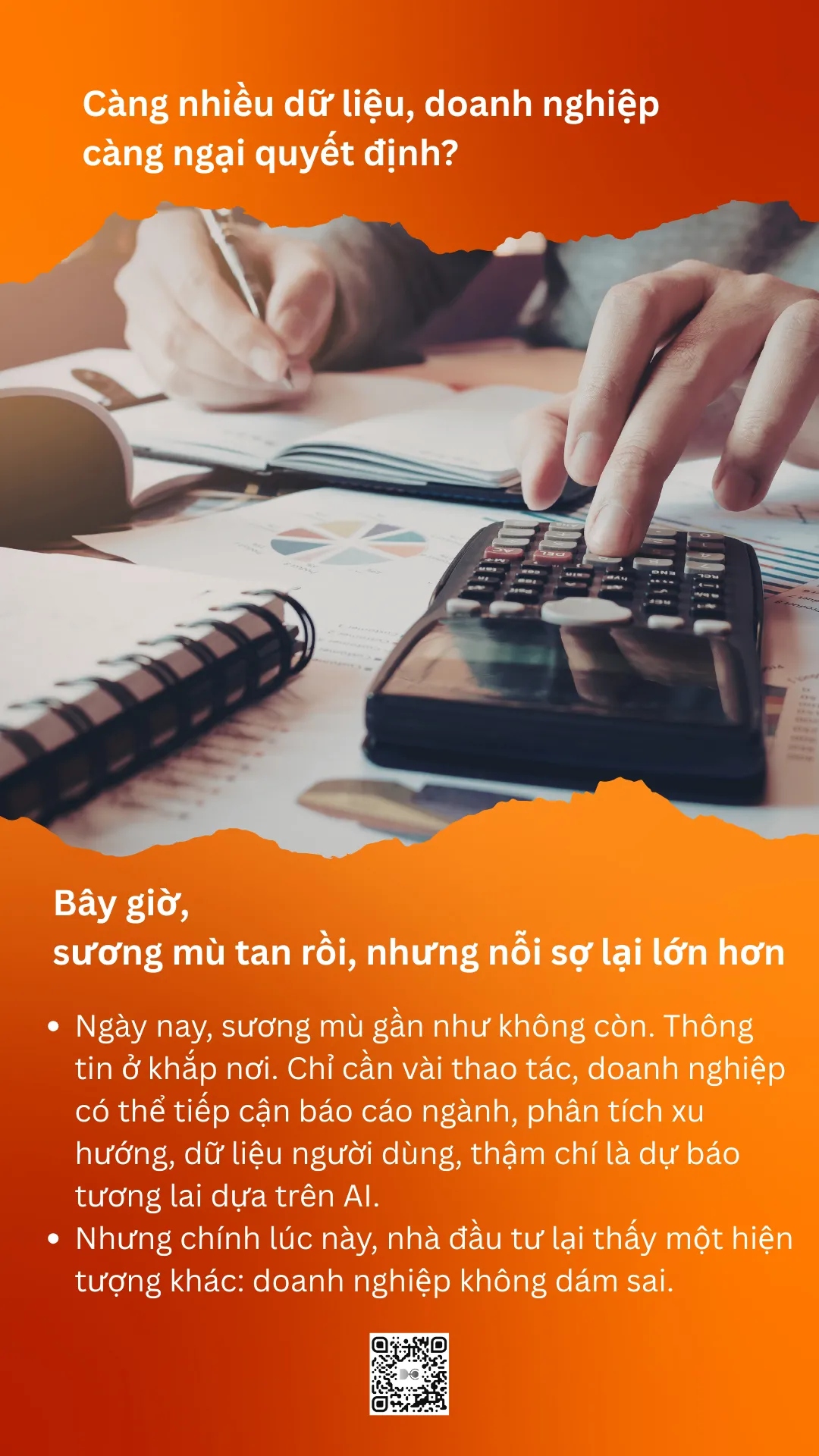
They’re afraid to make mistakes not because they’re certain they’re right, but because they see too many possibilities for error. Each new piece of data opens up a new scenario. Each new analysis reveals another potential risk. The decision is no longer a choice between right and wrong, but a choice between many “possibly right” and many “possibly wrong.”
And that makes signing the agreement more difficult than ever.
Investors are beginning to recognize a new type of risk: the risk of indecisiveness.
From an investor’s perspective, the biggest risk isn’t just making the wrong decision. It’s also about the inability to make the right decision at the right time.
There are businesses that have all the conditions to move forward: the market is still there, resources are sufficient, and the team hasn’t fallen apart. But they linger too long in a state of analysis, waiting for more data, waiting for clearer signals.

Investors understand that no decision is perfect. But they also understand that the market won’t stand still and wait for a business to reach absolute certainty.
When a business delays for too long, the question in an investor’s mind is no longer “is this the right decision?”, but “is this business still capable of taking responsibility for its decisions?”.
Too much information doesn’t make a business more confident; it reveals its fear.
Interestingly, the more information a business presents, the more investors sometimes sense the underlying lack of confidence.
This isn’t because the business isn’t competent. It’s because they’re trying to use information to mask an unanswered question: if things don’t go according to plan, how much can they handle?

The information answers the question “what could happen” very well. But it doesn’t answer the question “how much deviation from expectations can this business tolerate?”.
Investors don’t usually say this directly, but they observe very closely how a business reacts when asked about a worst-case scenario. Avoiding the question, giving vague answers, or constantly returning to data… all signal that the decision hasn’t been truly processed at a human level.
In the eyes of investors, decisions are about responsibility, not data.
There’s a major difference between how businesses and investors view decisions.
Businesses typically see decisions as optimization problems: choosing the option with the highest probability of success. Investors, on the other hand, see decisions as commitments: who will take responsibility if the chosen option fails to achieve its goal?

When information is scarce, the issue of responsibility is obscured. When information is abundant, responsibility becomes very clear. Because then, it’s impossible to claim ignorance.
And this creates greater psychological pressure on decision-makers. Not because they become weaker, but because they understand the cost of making mistakes more clearly.
Why do investors accept risk, but not prolonged uncertainty?
Investors are accustomed to risk. They don’t expect businesses to always be right. But they need to see that the business has consciously accepted that risk.
A decision made after facing the consequences head-on, even if the risk is high, is generally more respected than a decision that is indefinitely delayed due to fear of making a mistake. Because in that decision, investors see maturity in thinking, not just analytical ability.

Conversely, prolonged uncertainty leads investors to question: how will this company react when a worst-case scenario occurs? Will it continue to wait for more data, or will it have the courage to choose a course of action?
Let’s get to this point…
In times of information scarcity, businesses make mistakes because they don’t know.
In times of information abundance, businesses easily get bogged down because they know too much.
From an investor’s perspective, the issue isn’t whether or not to have AI. The issue is whether businesses have the ability to translate information into decisions and accept the responsibility that comes with those decisions.

Information can help reduce risk.
But only humans can resolve the uncertainty with a concrete choice.
And sometimes, that’s exactly what investors are looking for.