“What if you do nothing?” Is that a common question or action?
In business, not every mistake starts with a wrong decision. Many major business failures actually begin with a very familiar state: doing nothing.
Not because the business doesn’t see the problem.
Not because the business lacks data.
But because many initial signs often don’t seem serious enough to warrant immediate action.

The “What If You Do Nothing” section on the Mind Connector website is built around stories like these. These are real-life stories from various industries, where businesses have faced a warning sign – and chosen to wait a little longer.
The articles in this section are not intended to judge right or wrong. They are lessons learned from real-world situations, where each scenario offers a valuable lesson to consider.
Not all risks appear suddenly.
Looking back at major business failures, many people often think they happened unexpectedly. A market that changed too quickly. A competitor that suddenly appeared. A new technology that disrupted the industry.
But in many cases, risks don’t come that way.
They often begin with very small signs.

Sales growth has slowed for several consecutive quarters.
A group of customers has started switching to a different brand.
Operating costs have increased, but not significantly enough to cause concern.
A new trend has emerged, but it’s not yet clear enough.
These signals are often not strong enough to prompt immediate change. And that’s when the “no action needed” phase begins.
When things are still “not alarming”
In many businesses, the initial warning signs are often interpreted in a rather familiar way.
A slight drop in sales might be explained as seasonal factors.
A slight decrease in market share might be considered a temporary fluctuation.
A new competitor might be seen as not yet large enough to have an impact.

These arguments aren’t always wrong. In fact, in many cases the market can self-correct and businesses don’t need to change too much.
The problem is that nobody knows for sure at the time of the decision.
When businesses wait too long to act, those initial signals can develop into much bigger problems.
“Doing nothing” can sometimes be a decision.
In business management, we often think that decisions only happen when there is action: expanding the market, investing in factories, launching new products.
But in reality, there is another type of decision that is rarely mentioned: the decision to change nothing at all.

When a business sees a market signal but chooses to wait.
When an operational problem arises but isn’t addressed immediately.
When a new opportunity emerges but the business isn’t ready to seize it.
In all of these situations, inaction is also an option.
And like any other choice, it can have consequences.
The Stories Behind This Column
Mind Connector has had the opportunity to work with and observe many businesses across various industries: from fast-moving consumer goods, retail, and F&B to manufacturing and services.
During this process, a common thread has consistently emerged.
Many major business problems don’t stem from an obvious strategic mistake. They begin with very ordinary situations:

An expansion plan was delayed for too long.
A change in customer behavior went unnoticed.
An operating system began to overload but wasn’t adjusted.
At the time, no one thought these problems would become serious. But looking back a few years later, they turned out to be crucial turning points in the business’s journey.
The stories in this column are built from those very experiences.
Not for judging right or wrong
It’s important to emphasize that the goal of this section is not to indicate which businesses were right or wrong.
In business, every decision is made within the context of the time. A choice may be perfectly reasonable when it is made.
Only in retrospect do we see factors that were not previously apparent.

Therefore, the stories in this section are written with the spirit of sharing experiences, not criticism.
In many cases, the business names will be hidden or described according to their industry instead of being specifically mentioned.
What matters is not which business it is, but the lesson behind the situation.
Every industry has its “times of doing nothing.”
In retail, there are times when businesses see changes in consumer behavior but aren’t in a hurry to adjust their store models.
In the F&B industry, there are periods of rapid chain growth, but the operating system hasn’t yet been standardized.
In manufacturing, there are times when capacity is expanded based on market forecasts, but demand begins to slow down.

These stories are not isolated incidents. They occur in many different industries, at various stages of business development.
And the common thread often lies in a small moment: the moment a business could have acted, but chose to wait a little longer.
The Value of Past Experiences
In business, the most valuable lessons are often not found in books or theoretical models. They come from situations that have actually occurred.
A business can learn a great deal from its own experiences. But sometimes, we can also learn from the experiences of other businesses.

The stories in the “What If You Do Nothing” column are shared with that spirit in mind.
Not to find a one-size-fits-all formula for every business.
But to help readers gain a different perspective when faced with initial market signals.
When you see early warning signs
Not every early warning sign requires an immediate response. In many cases, patience and observation are also a sound strategy.
But it’s crucial that businesses recognize they are faced with a choice.
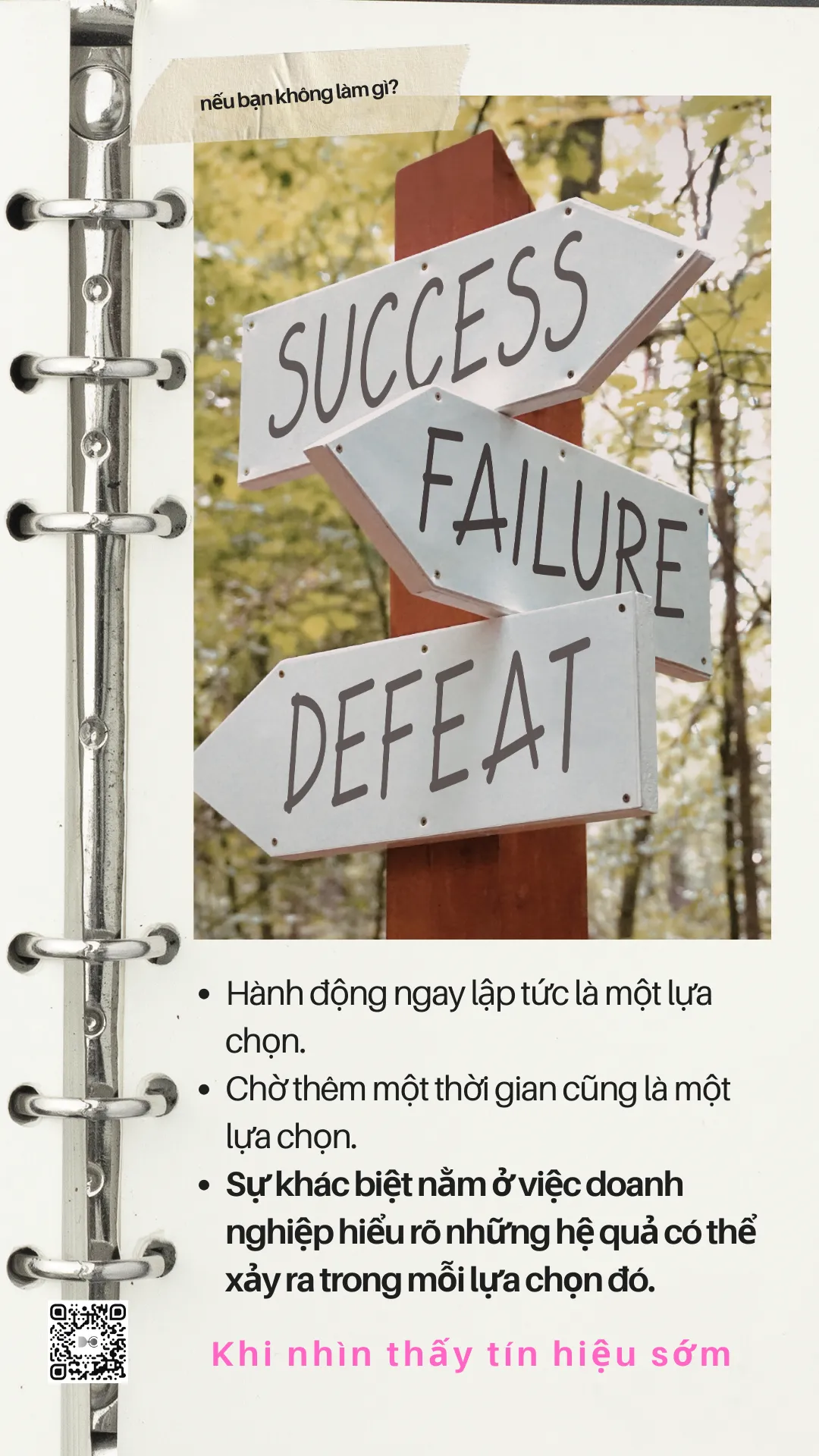
Taking immediate action is one option.
Waiting a little longer is also an option.
The difference lies in whether the business understands the potential consequences of each option.
“What If You Don’t Do Anything?” – A column dedicated to practical lessons
The “What If You Don’t Do Anything” column will continue to share such stories from various industries and in diverse business contexts.
Each article will present a specific situation: an initial warning sign, a delayed decision, and what happened afterward.

These aren’t stories of failure, nor are they theoretical lessons.
They’re simply experiences that have happened in the real world of business.
And sometimes, just reading one such story is enough for a business to realize that: there are moments in business when the important thing isn’t to do a lot of new things.
But to not ignore the small signals as soon as they appear.