There’s an increasingly common practice in the working process between investors and experts. And sometimes, this leads to unnecessary complications for the relationship between the two parties.
Investors enter projects with a rather relaxed mindset: all the information is available, the platforms are readily accessible, the AI strategy is well-written, so things like initial research, in-depth analysis, or risk assessment seem unnecessary.

Meanwhile, experts approach the same project with the opposite feeling: the more information available, the more crucial it is to thoroughly review the foundation, because even a slight deviation in input can make the entire subsequent execution process extremely difficult to salvage.
This gap isn’t about who is right. It arises almost inevitably, and if not confronted directly, it becomes the source of numerous problems during the work process.
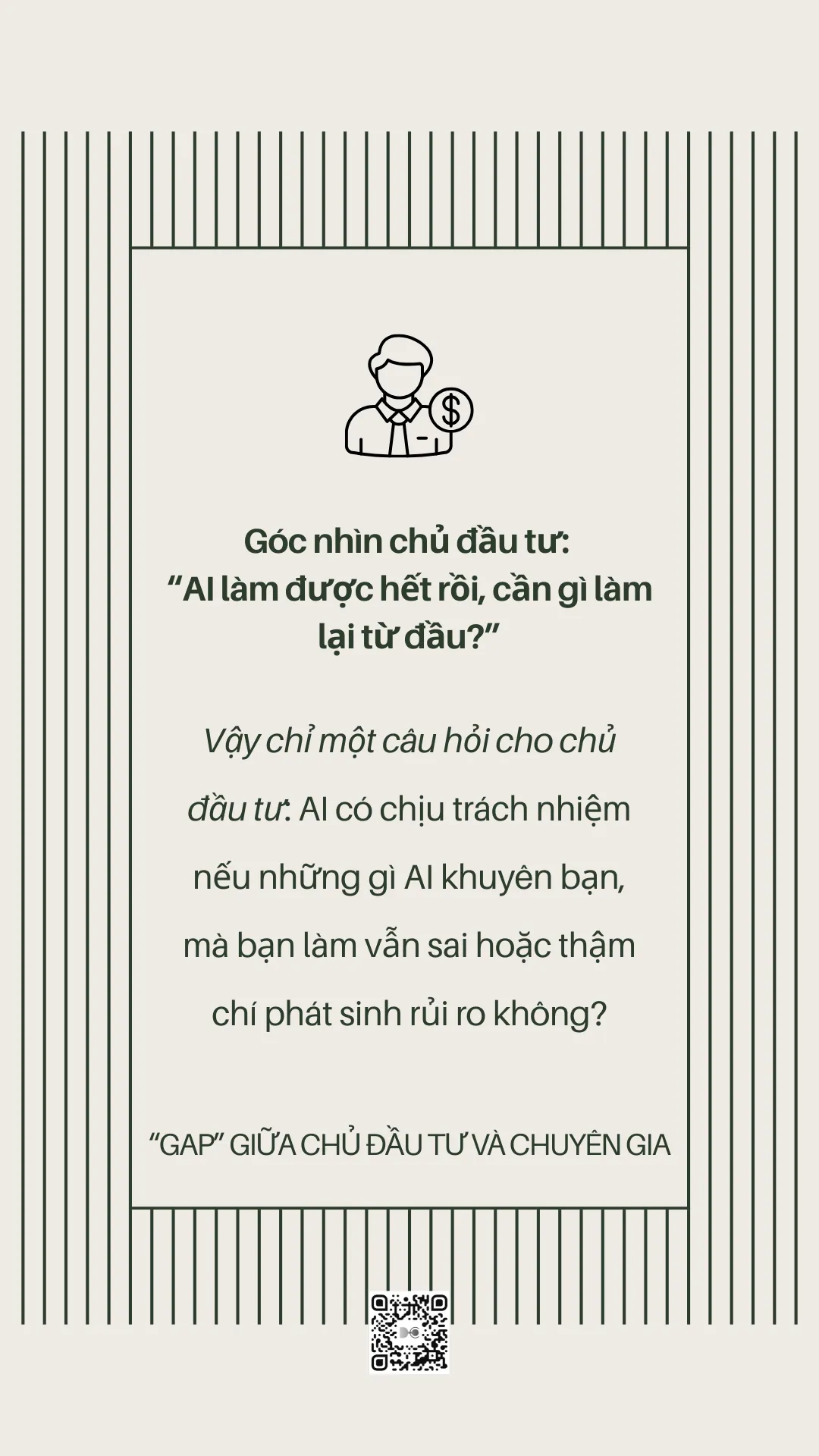
From the investor’s perspective: “AI can do everything already, why start over?”
For many investors, especially those with extensive project experience, seeing AI synthesize information, write strategies, and even create fairly detailed action plans is very convincing.
They look at it and find it logical. No obvious errors. No missing points. It even saves a lot of time compared to traditional methods. In a context where speed and cost optimization are crucial, skipping fundamental steps like re-researching the market, re-analyzing risks, or dissecting the strategy seems like a reasonable choice.
From this perspective, the expert’s request to “start over” is easily perceived as unnecessary perfectionism, or worse, as prolonging the project to increase the workload.
The client doesn’t think they’re downplaying the risks. They just believe the risks have already been “calculated in the data.”
So, the only question for the client is: Will AI be held accountable if what the AI advises is still wrong or even results in risks?
From this perspective, the expert’s request to “start over” is easily perceived as unnecessary perfectionism, or worse, as prolonging the project to increase the workload.
The client doesn’t think they’re downplaying the risks. They just believe the risks have already been “calculated in the data.”
So, the only question for the client is: Will AI be held accountable if what the AI advises is still wrong or even results in risks?
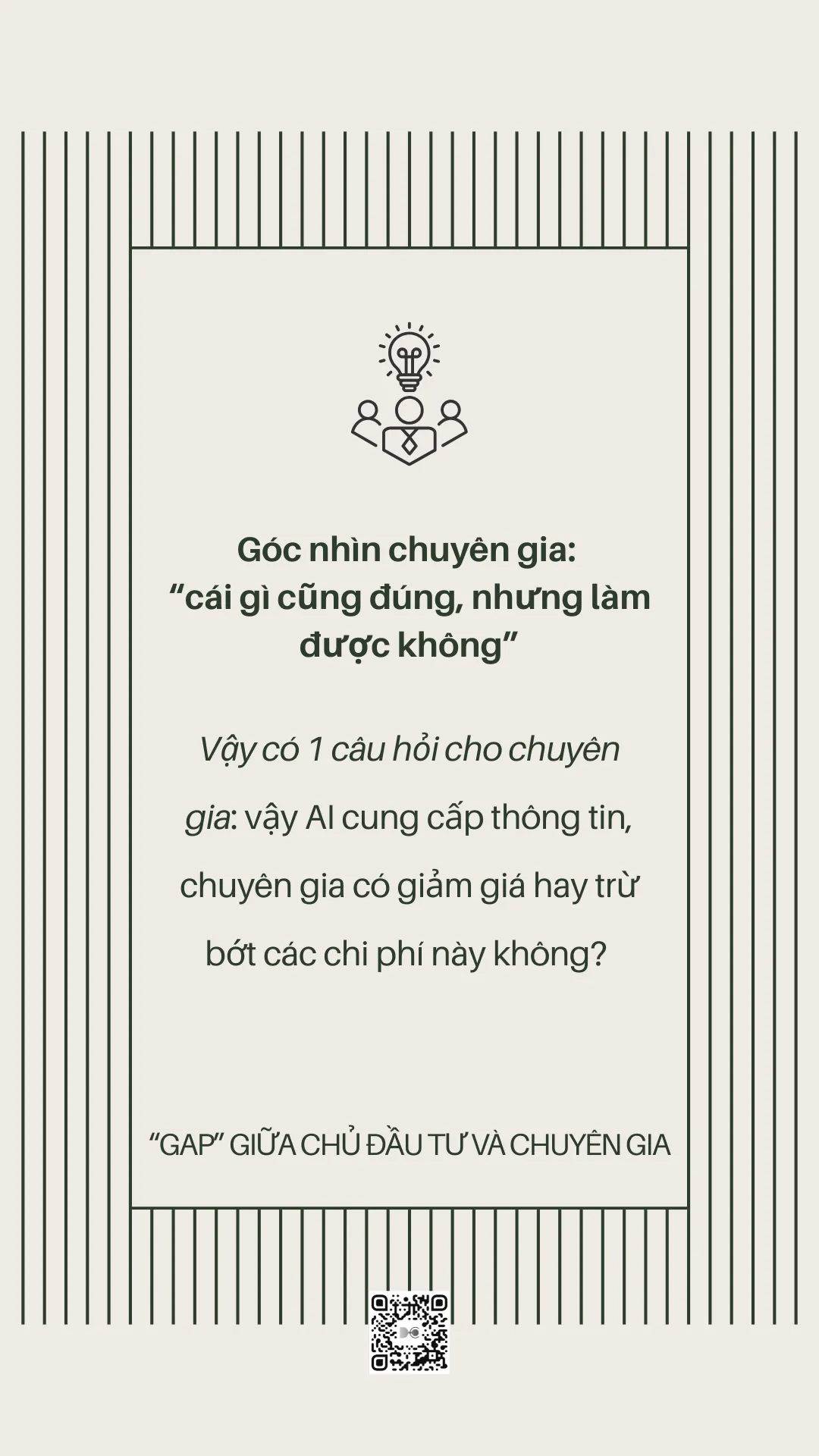
Experience has taught experts that the hardest part of a project rarely lies in the strategy, but in the unspoken assumptions. And these assumptions are often overlooked when everything is built from readily available data.
So, the question for experts is: if AI provides the information, do experts reduce or subtract from these costs?
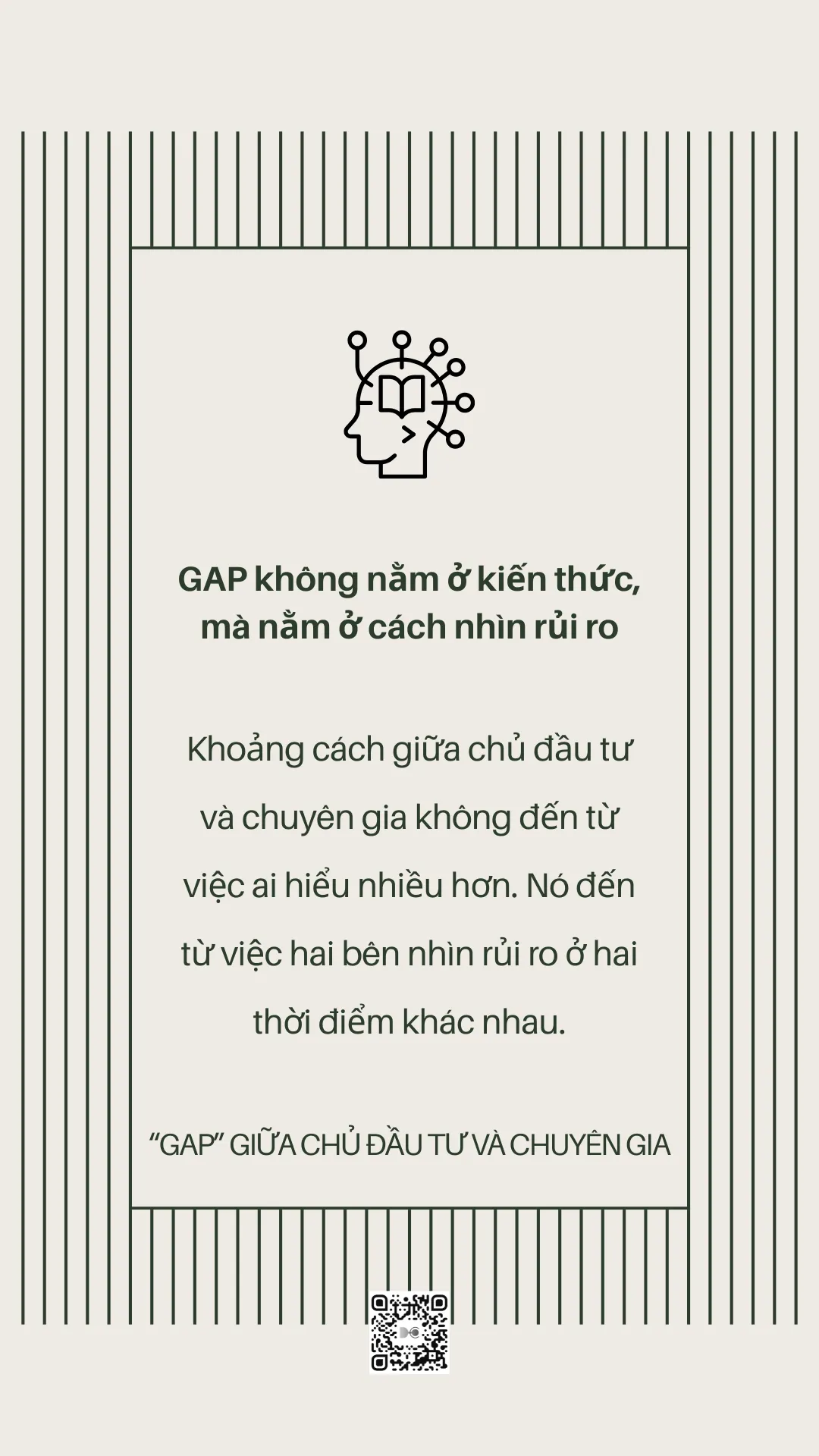
Gaps don’t lie in knowledge, but in how risk is viewed.
The gap between investors and experts doesn’t come from who understands more. It comes from the fact that they view risk at two different points in time.
Investors typically view risk at the decision-making stage: risk that is measurable, predictable, and acceptable or not.
Experts, on the other hand, view risk at the execution stage: risk that arises when people are tired, when resources are stretched, when the market reacts differently than expected, and when “unforeseen” factors begin to appear.
Because they view risk from two different points on the same journey, gaps are inevitable.
When the GAP isn’t communicated, problems begin to arise.
Many issues in the work process don’t stem from competence, but from differing expectations.
The client thinks the expert is overcomplicating things that are already in place.
The expert, in turn, thinks the client is underestimating the implementation risks.
This gives rise to familiar feelings:
the expert feels unheard,
the client feels pressured, and the expert feels ineffective because “this is what AI is saying, right???”
and the project gradually drifts into a “get it done” state.
No one is wrong, but the results often fall short of initial expectations.
What can investors do to narrow this gap?
The important thing isn’t to revert to old ways of doing things, nor to deny AI. The issue is putting AI in its proper place.
AI can very effectively replace information gathering and synthesis. But investors need to clearly distinguish between information, assumptions, and unverified data from their own business.
Instead of asking, “Can AI do this yet?”, try asking a different question: if this part doesn’t go as expected, where will the business stumble first? That question shifts the focus from “is it right or not” to “can we handle it?”.
What changes do experts need to make to avoid being pushed further away?
From the experts’ perspective, a very real challenge is the approach. Simply saying “AI isn’t enough,” “doing it is risky,” or “we need to start over” will only widen the gap.
Experts need to be more specific about the implementation consequences, rather than emphasizing the process. Instead of saying “further analysis is needed,” they should be asking, “If this point isn’t clarified, at what stage will the risks arise, and who will bear the burden?”
When risks are linked to specific consequences, investors are much more likely to listen.
The gap isn’t disappearing, but it’s manageable.
The gap between investors and experts will never completely disappear, especially in an era where AI makes everything seem so much easier.
But the gap isn’t a bad thing. It only becomes a problem when both sides pretend it doesn’t exist.
When investors accept that data doesn’t replace the responsibility of execution, and when experts accept that they no longer have a monopoly on information, the two sides can meet at a more realistic point of common ground.
At this point?
AI can do a lot of things. But precisely because it can do so well, it easily creates the illusion that the original foundation is no longer important.
In reality, the foundation hasn’t disappeared. It has simply shifted from finding information to understanding the limitations of humans, and the organization will then implement that decision.
The gap between the investor and the expert is almost unavoidable. But if both sides confront this gap directly, instead of avoiding it or arguing about right and wrong, then that very gap can become what helps the project go further, instead of collapsing midway.