In investor meetings, there’s a question rarely asked directly, but almost always on their minds.
It’s not “how much revenue?”,
not “how big is the market?”,
but rather: Does this business understand what it’s betting on?
Investors don’t expect a business to be risk-free.
They only fear one thing: risks that the business itself hasn’t even considered.

Risk itself doesn’t scare investors. Ambiguity does.
A business that walks into an investment meeting saying, “We have the risks under control,” doesn’t inspire confidence. On the contrary, it makes investors wary.
Because in reality, investors understand very well that no business grows without risk. The question isn’t whether risk exists, but whether the business knows where it is and how big it is.

Some businesses speak very positively about opportunities, potential, and the market. But when asked more deeply about worst-case scenarios, their answers are often vague or evasive. This isn’t because they’re hiding anything, but because they’ve never truly analyzed the risks from a decision-making perspective.
For investors, this is a bad sign.
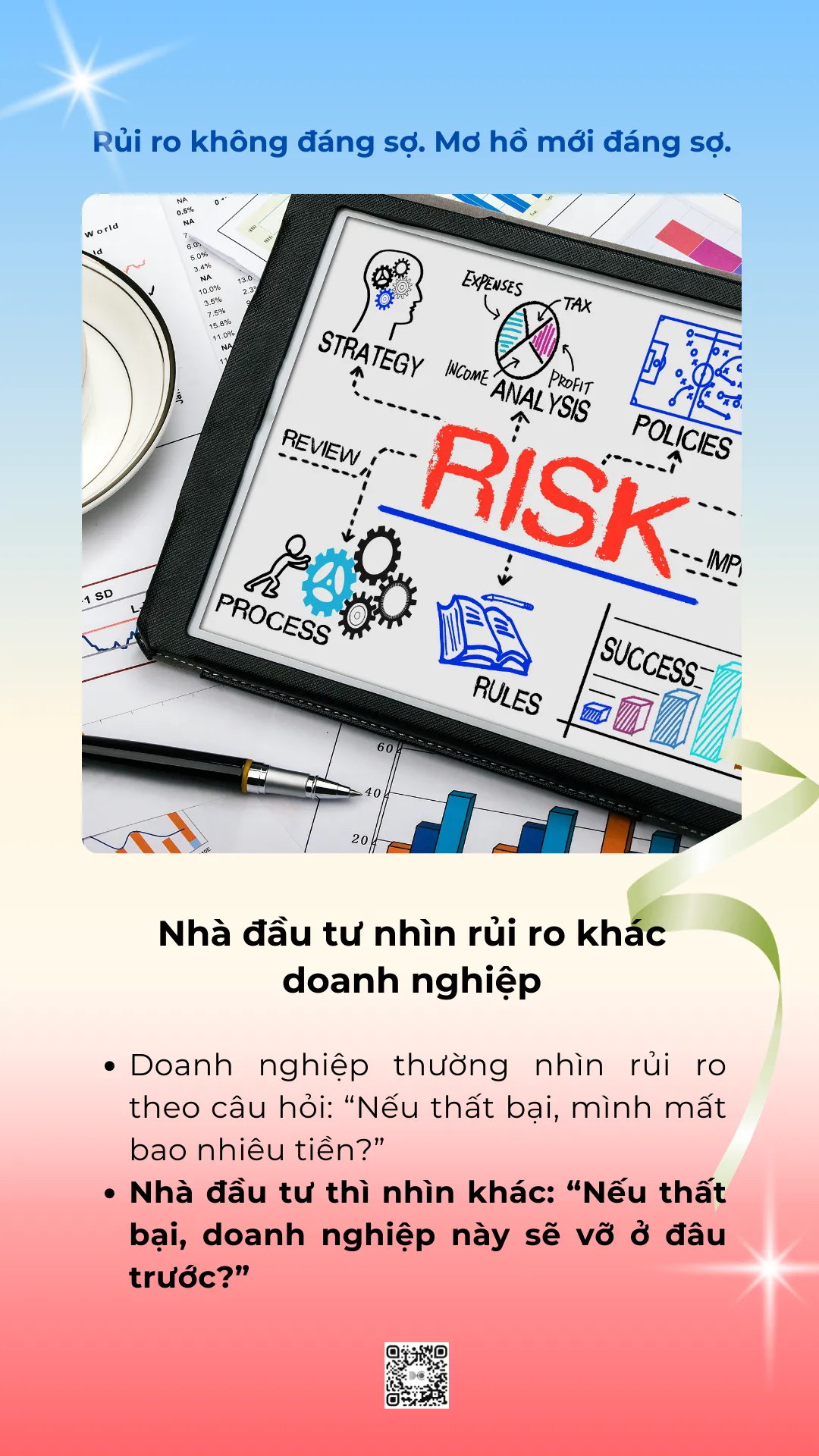
Investors view risk differently from businesses.
Businesses typically view risk by asking:
“If we fail, how much money will we lose?”
Investors, however, view it differently:
“If this business fails, where will it collapse first?”
It could be:
- Collapse due to insufficient cash flow to handle the growth rate
- Collapse due to a team lacking the capacity to operate on a new scale
- Collapse due to internal conflicts arising from shifts in power and interests
- Collapse due to the founders no longer having the strength to continue
These risks aren’t always explicitly stated in a business plan. But investors always pay attention to how a company talks about – or doesn’t talk about – them.
These risks aren’t always explicitly stated in a business plan. But investors always pay attention to how a company talks about – or doesn’t talk about – them.
One signal that makes investors wary is when a company always presents everything as if it has been meticulously planned, with contingency plans for every scenario, and the possibility of failure is almost zero.
This isn’t because investors don’t believe in the company’s capabilities.
It’s because they know that business decisions rarely unfold exactly as predicted.

Investors tend to trust businesses that are upfront and transparent:
- What I’m not sure about
- What I’m betting on
- And what I’m willing to lose
That honesty doesn’t weaken the business in the eyes of investors. On the contrary, it shows that the business has genuinely thought seriously about the risks, rather than just focusing on raising capital.
DMR is what helps investors understand how a business is making decisions.
DMR, short for Decision Making Risk, is what Mind Connector calls its 2026 development service package, focusing on assessing risk in the decision-making process. This isn’t a generic term, but rather Mind Connector’s own approach.
For investors, DMR isn’t just a report to read; it’s a way to look into the logic behind a business’s decision-making.

It’s not about which option the business chooses, but rather:
- Why did they choose that option?
- What are they sacrificing?
- And how deeply do they understand the risks involved?
A business might choose a high-risk option. Investors aren’t afraid of that. What they’re worried about is that the business isn’t aware of the level of risk it’s taking, or that it’s assessing it based on emotion.
When a company doesn’t assess its own risks, investors will do it for it.
There’s a rather blunt reality: if a company doesn’t clarify its own risks, investors will do it for it.
And when risk is viewed from the investor’s perspective, it often becomes harsher. Not because investors are difficult, but because they don’t live within the company. They have no obligation to protect internal sentiments or beliefs.

Many deals fall through not because the businesses are incompetent, but because the two parties perceive the risks too differently and fail to find common ground before going too far.
Where does Mind Connector stand between businesses and investors?
Mind Connector doesn’t side with the investor. Nor does it side with the business. We stand in the middle, clarifying the logic behind decision-making before both parties enter into long-term commitments.
DMR helps businesses clearly articulate their risks, not to damage their profile, but to avoid false expectations from the outset. When businesses understand what they are betting on, investors can more easily assess the suitability of the deal.
In many cases, DMR doesn’t speed up the deal. But it helps the deal move in the right direction and reduces the likelihood of failure due to misunderstandings about risk later on.

Let’s take a look back?
Investors aren’t looking for perfect businesses. They’re looking for businesses that understand the game they’re playing.
Risk isn’t a drawback.
Apathy is what makes investors hesitate.

And sometimes, what makes a business chosen isn’t that it’s less risky, but that it’s mature enough to look directly at its own risks before asking others to join in.