There’s a feeling many business owners have experienced, but rarely talk about.
It’s when you’re faced with a crucial decision, and everything seems fine on the surface. Reports are there. Analyses are there. Consultations are readily available. You even ask the AI, and the answers sound convincing. Nothing seems obviously wrong. But nothing truly reassures you.
That feeling doesn’t stem from a lack of understanding. It comes from the intuition of the person in charge. An intuition that’s hard to name, but one that tells you that if anything goes wrong, the first to pay the price won’t be the reports, or the AI, but you, the business owner.
When you have enough information, the problem lies elsewhere.
The reality is that most businesses today no longer lack data. The market is constantly analyzed. Trends are updated daily. Competitors are dissected in detail. Internal reports are available, external consultants are available, and AI is ready to answer any question asked.
But the more information there is, the heavier the decision becomes. Not because it’s more technically complex, but because businesses are beginning to realize more clearly that information gives them many options, but doesn’t help them understand the consequences of each option.
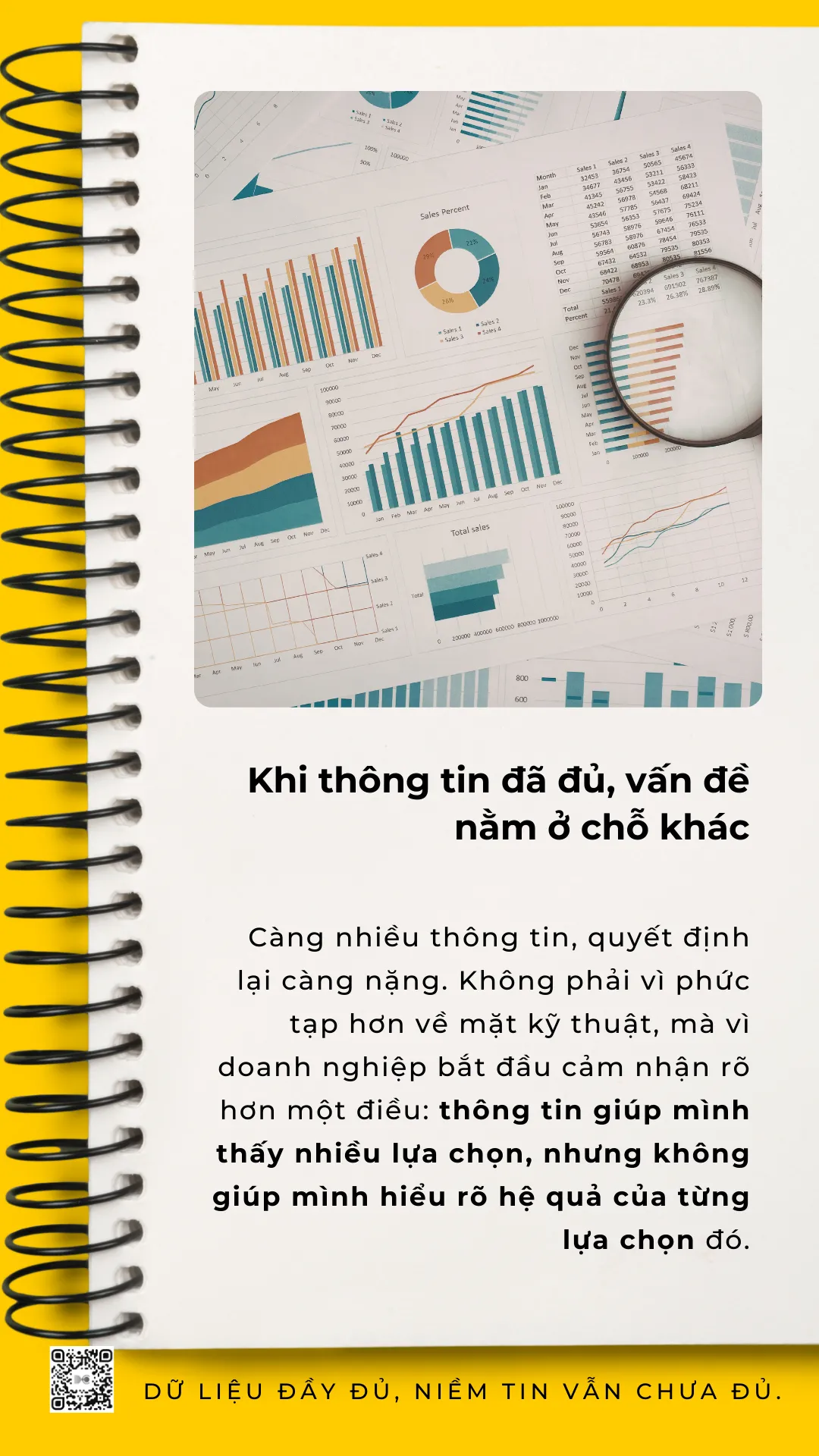
A decision isn’t just about choosing the option that seems better. It’s about accepting a series of consequences, some of which are immeasurable. And it’s precisely these immeasurable consequences that cause decision-makers to hesitate.
AI is very good at answering, but it doesn’t live by the decision.
AI isn’t wrong when it comes to data aggregation, scenario analysis, or making reasonable suggestions. In terms of information processing, AI is very fast and efficient. But AI isn’t the one who will live by the decision.
AI isn’t the one to face the team when a new strategy leaves them confused. AI isn’t the one to maintain the company culture during stressful periods. AI isn’t the one to bear the pressure when cash flow isn’t going as expected, even if everything looked great on the spreadsheet.
The difference lies not in intelligence, but in responsibility. Business decisions not only produce results, but also consequences. And consequences are always linked to people, to beliefs, to resilience, and to relationships built over many years.
The real risks are often not in the data.
There’s a rather unpleasant truth: the biggest risks in a business are often not in the reports. They lie in things everyone senses, but are rarely brought up as official variables.
It could be the persistent fatigue of the leader, where each new decision demands additional energy that no one sees. It could be a team working out of habit, still completing tasks but no longer truly believing in the new direction. It could also be underlying internal conflicts, not yet large enough to explode, but enough to slow down any efforts at change.

These factors aren’t wrong in terms of data. But they heavily influence whether a strategy will succeed. And this is precisely the gap that adding more data or analysis can’t fill.
DMR [Decision Making Risk] is what Mind Connector calls the process of reviewing risk during decision-making.
DMR, short for Decision Making Risk, is the name Mind Connector uses for a service package developed for 2026, focusing on risk assessment in the decision-making process. It’s not a generic term, nor is it an academic framework.
DMR begins with a very simple assumption: what makes businesses insecure isn’t a lack of options, but a lack of understanding of the cost of the option they’re about to choose. Instead of trying to find the “best” decision, DMR focuses on clarifying the overlooked trade-offs, the underestimated risks, and the actual consequences a business will face if things don’t go as expected.
Here, the focus isn’t on the question of “what should I do?”, but on the question of “what am I accepting when I do this?”. Once that question is answered clearly enough, the decision usually becomes easier, though still difficult.
It’s not always necessary to consult an expert, but there are times when self-determination is not advisable.
There are periods when a business can completely assess risks itself. When the model is simple, decision-making is centralized, and the consequences of each choice are still within control, self-assessment is reasonable and necessary.
However, as the business grows, decisions no longer affect a small group but impact multiple layers of people, overlapping interests, and differing expectations. Self-determination sometimes ceases to be proactive and becomes a form of risk.

At that point, what the business needed wasn’t more advice, but an independent perspective to re-examine its own decision-making logic. Not to be persuaded, but to see more clearly what was being overlooked.
Where does the Mind Connector stand in this process?
The Mind Connector doesn’t make decisions for the business. Nor does it aspire to make every decision safe. In reality, no decision is completely safe.
The role of the Mind Connector in DMR is to help the business see things more clearly before signing. It helps them see what they are trading off, whether they are truly prepared for the consequences, and what risks the business cannot tolerate, even if the probability of occurrence is low.
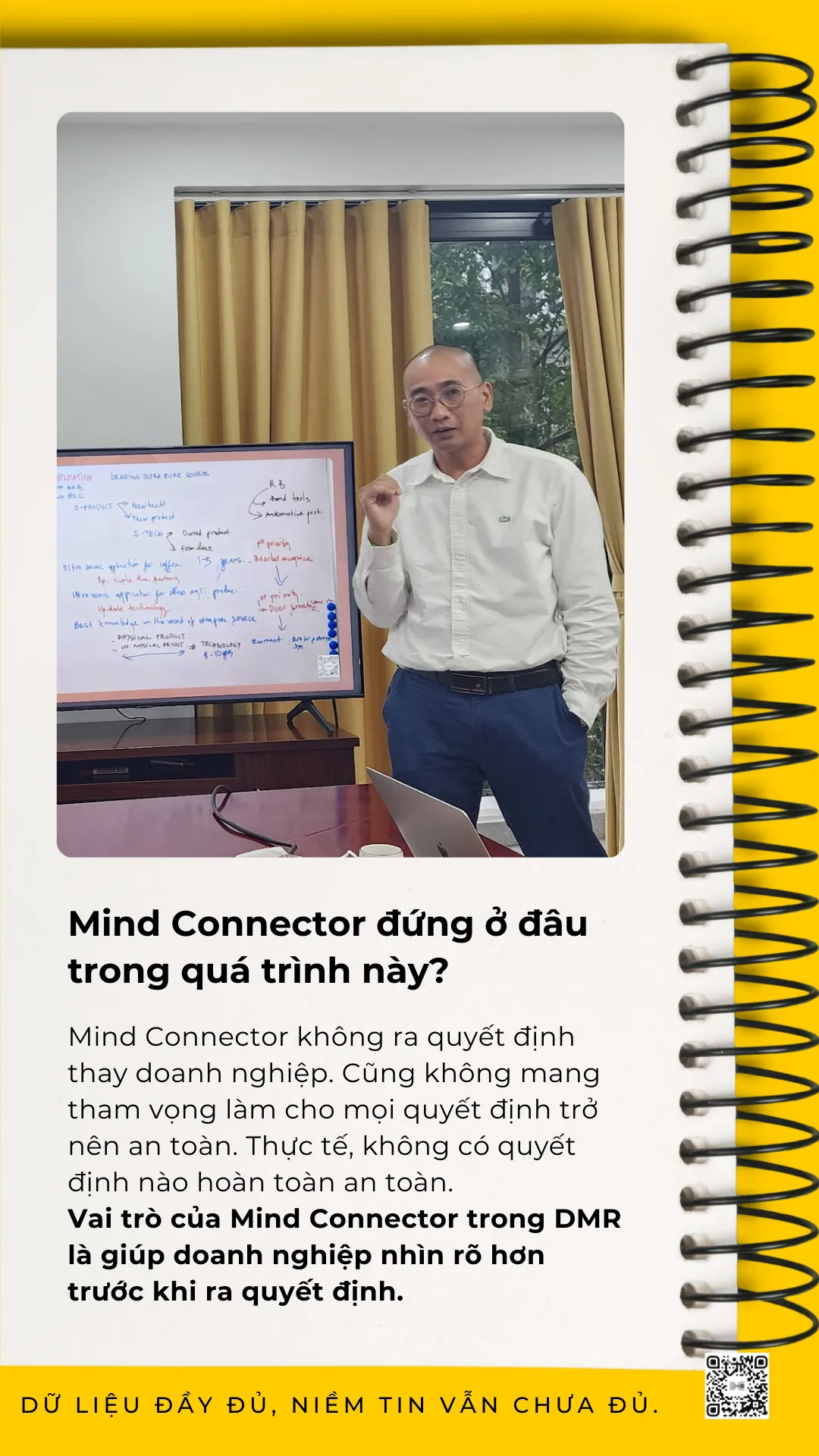
The decision ultimately rests with the company. But it’s a decision made with an understanding of where they’re going, not simply because everything on paper seems logical.
Therefore,
In a world where information is increasingly abundant, AI is increasingly intelligent, and everything can be analyzed, the advantage doesn’t lie in knowing something new. The advantage lies in understanding yourself better before making a decision.
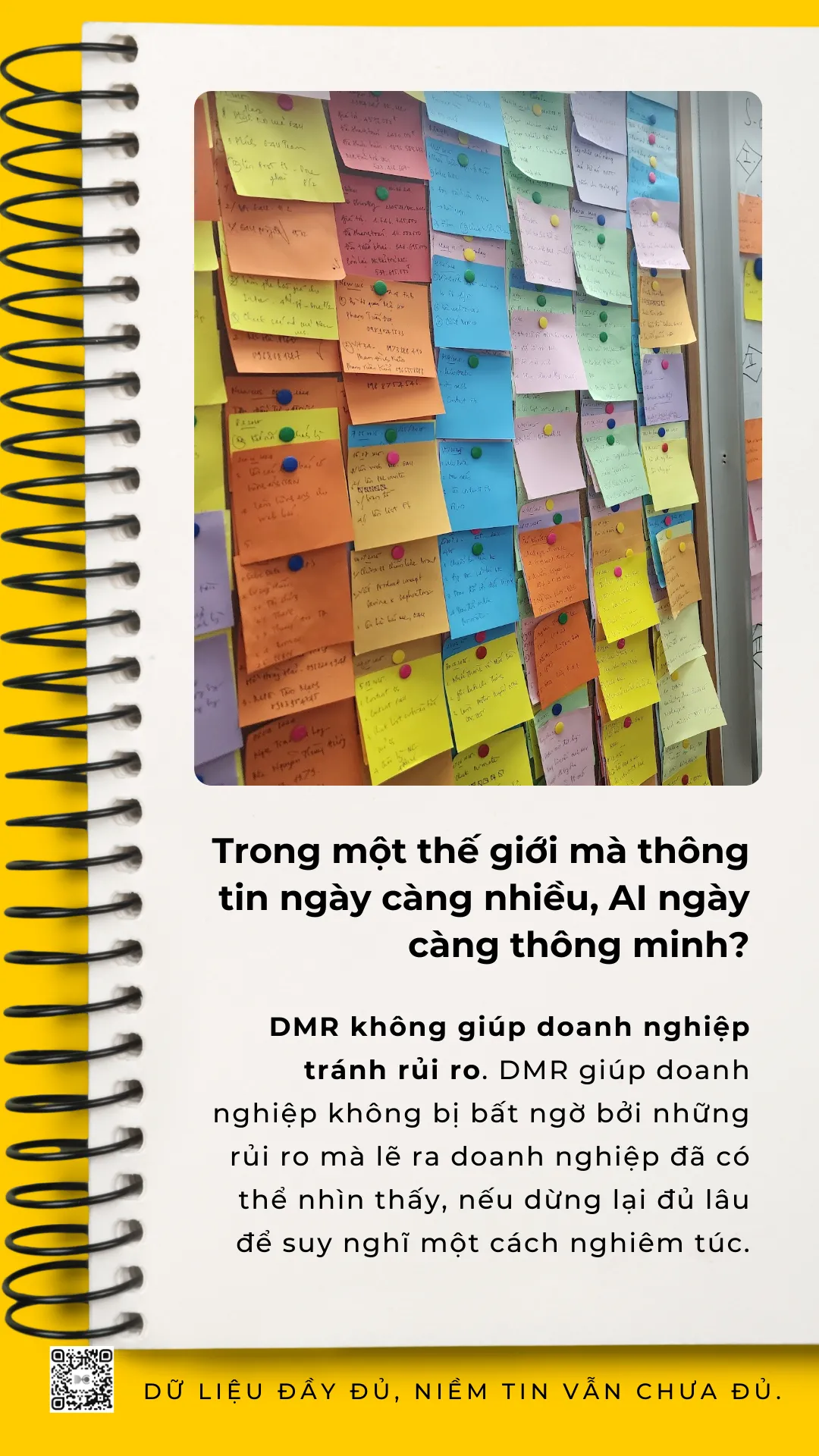
DMR doesn’t help businesses avoid risk. It helps them avoid being caught off guard by risks that they could have foreseen if they had paused long enough to think seriously.
And sometimes, that’s all it takes to make a decision much less burdensome.